Stress relief games can be a good way to unwind after a day, as long as you pick the right kind and treat the game as a break, not a treatment. This page covers what helps in a game when you are tired or tense, what to skip, how long to play, and where Night Shift fits, honestly.
What a game can and cannot do
A game can give your mind something else to hold for a few minutes. That can feel like relief, the same way a walk or a cup of tea can. It is not therapy, and no game should replace sleep, rest, company or help from a professional if stress is heavy or long-lasting. Everything below is practical advice about enjoyable pastimes, with no claim that any game treats anything.
What helps
- Absorbing but simple. A game that takes your full attention without needing hard decisions leaves little room for the day's worries.
- A steady rhythm. Repeating small actions in a predictable beat settles many people.
- Satisfying clears. Something visibly getting tidy, a row vanishing or a pile becoming level, ends the session on a small win.
- Cheap mistakes. If a slip costs seconds, you stay relaxed. If it costs an hour, you tense.
- Easy to start and stop. No long setup, no logins, nothing that lingers.
- Quiet. Gentle sounds, or none at all.
What to skip when you are already tense
- Competitive ladders. Being ranked against strangers rarely helps you wind down, though some people enjoy it.
- Harsh timers. A countdown that ends your game keeps the clock in your head.
- Games built to be repeated for rewards. If the pull is a reward schedule, not enjoyment, you may feel worse afterwards.
- Anything that makes you angry. If you swear at the screen, stop.
- Heavy spending prompts. A game that keeps asking for money is a bad companion for a tired mind.
| Your mood | Try | Avoid |
|---|---|---|
| Wound up, restless | Slow puzzles, tidying games | Fast games with a harsh clock |
| Tired, foggy | Simple repeating games, short sessions | Complex strategy |
| Bored and tense | A moderate arcade game with a rhythm | Endless grinds |
| Angry | Something else for a while | Competitive modes |
How long to play
Short is better. A good rule is to decide before you begin: one round, one shift or ten minutes. Then stop when it is over, even if you are doing well. The point of a break is to return to your day, not to swap one pull for another. If you reach for a game every time you feel stressed and it no longer helps, that is useful information, and a reason to try a walk, some water or a conversation.
Late evening deserves care too. A bright, exciting game right before sleep may keep you awake, so choose something calm, lower the brightness and put the phone away at a set time.
Where Night Shift fits
Night Shift is an arcade stacking game: a crane drops crates into eight columns, you push them into place, and every full bottom row ships out for points. Ship eight rows to finish a shift with a bonus. Here is a straight look at it for an unwinding session.
- Helps: a clear rhythm of drop, push and ship; rows that vanish; no countdown that ends your game; cheap restarts; offline play with a save whenever you pause or leave; sound and music switches at the top left.
- Watch: the crane gets faster every shift, so it is calmest in the first ones. Later shifts add power cuts, a second crane and extra dynamite, which can wind you up rather than down.
- Optional pressure: shifts set tasks for a bigger bonus, a daily challenge and a leaderboard exist, and a streak counts days. You can ignore all of them, and the page on the daily challenge explains them if you wish to know.
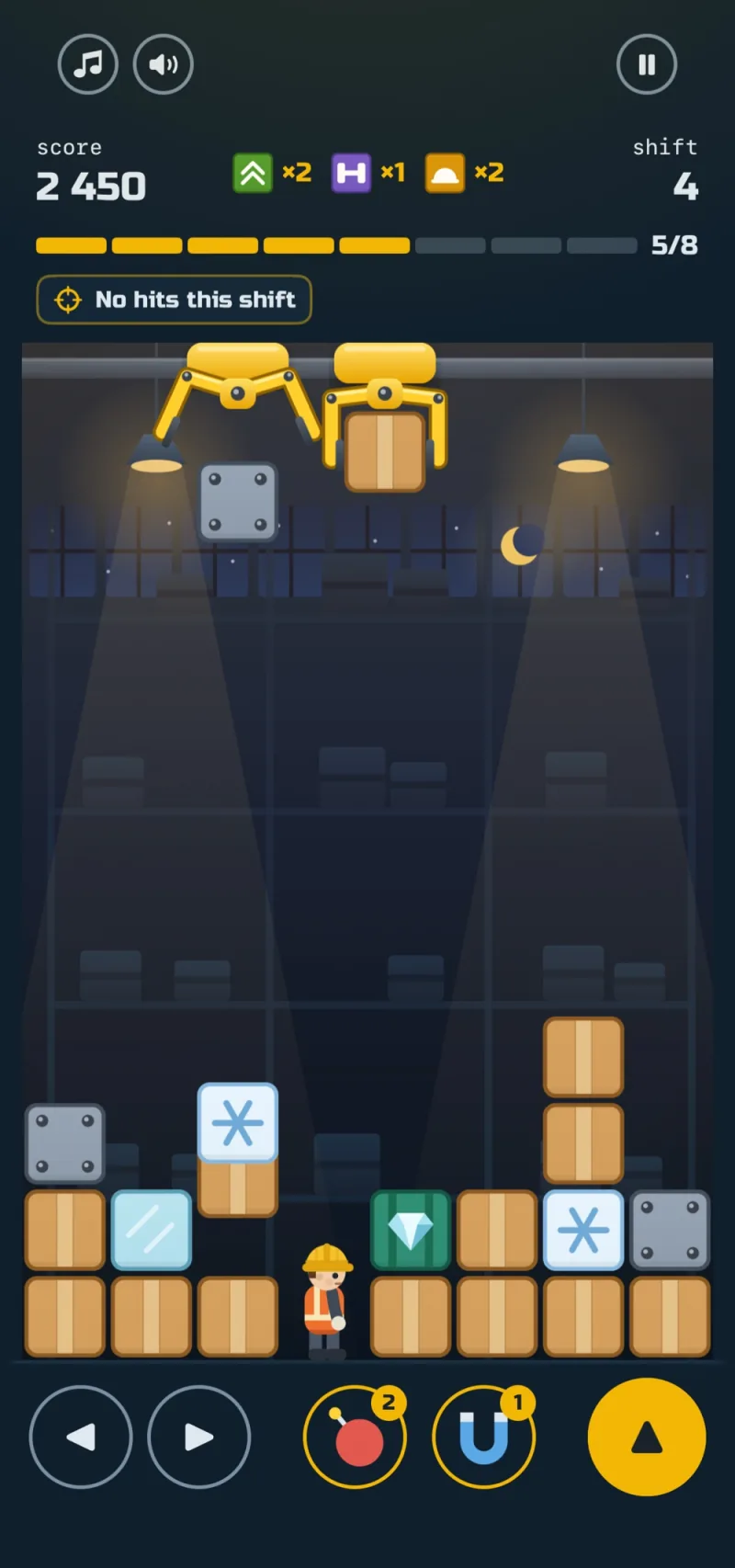
A sensible way to use it for unwinding is to play the first shift or two, keep the floor tidy and stop at the shift card. The settings let you start from any shift between 1 and 5, but for a calm session shift 1 is the gentlest. The tips help you keep the floor flat, which is most of staying calm. For the ads question: they are only optional videos you choose, and coins and supply crates are optional purchases.
A five-step wind-down routine
- Put the day away: close work apps and silence notifications.
- Pick one game and decide how long, before you start.
- Play at an easy pace. If it becomes tense, stop or switch.
- Stop at a natural pause, such as the end of a shift, and put the phone down.
- Do something with no screen for five minutes: stretch, water, a window.
If stress is persistent, if it affects sleep or mood for weeks, a game is not the answer, and talking to a doctor or someone you trust is.
Do stress relief games really work?
Many people find a short, absorbing game a pleasant break, but a game is not a treatment. For heavy or lasting stress, seek proper help.
Is Night Shift good for unwinding?
The early shifts are calm and there is no countdown that ends the game. It speeds up as you go, so stop when it stops being relaxing.
Can I play it without a connection?
Yes. Games, including the daily challenge, play offline. Only ads, the shop and leaderboards need a network.
More on the topic: how to play for the rules.