Casual games are games you can learn in a minute, play for a few minutes and put down without losing anything, and the word describes how a game fits into your day rather than how simple it is. This page explains what makes a game casual, the main kinds of casual puzzle games, and why casual and easy are different things.
What makes a game casual
Three things most often make a game casual. It is quick to learn, because a few seconds of looking is enough to understand the goal. It is quick to play, with sessions that last a minute or two or can be paused at any time. And it is forgiving about interruptions, so putting it down does not wreck anything.
| Trait | Casual | Not casual |
|---|---|---|
| Learning | A minute or less | A long tutorial or a manual |
| Session | A few minutes, paused at will | Long, with no safe place to stop |
| Commitment | Pick up and put down | Needs a schedule or a team |
| Controls | A few simple actions | Many buttons and combinations |
A game does not need all four to be casual, and the line is blurry. It is a spectrum, and most players sit at different points on it on different days.
The kinds of casual game
The word covers a wide range. These are the main kinds of casual puzzle games and simple games people search for:
- Match and swap games, where you line up pieces of the same kind.
- Block and stacking games, where pieces or crates fall and you fit them together.
- Word and number games, where a short puzzle has one right answer.
- Hidden object and spot-the-difference games, which reward patience.
- Simple arcade games with one or two actions and a score to beat.
- Idle and clicker games, where progress continues while you are away.
Casual is not the same as easy
The biggest misunderstanding is that casual means easy. It does not. Casual describes access: how fast you can start. Difficulty describes the ceiling: how hard it gets when you want it to. Plenty of casual games are hard to master, which is part of why they last. A game with simple rules and deep consequences can be played by a beginner in a minute and still hold an expert for years.
The test is whether the first minute is friendly while the tenth hour is still interesting. Games that fail the first half are hard to start. Games that fail the second half run out quickly.
Night Shift as a casual game
Night Shift is a casual game with a sharper edge. The first minute is simple: a crane drops crates into eight columns, you push them into place, and a full bottom row ships out for points. You can pause at any time, and the game is saved when you leave. It plays offline, so it works in a waiting room. But the later shifts get faster, with a second crane, steel, dynamite and power cuts, so the ceiling is high. Shipping eight rows finishes the first shift and collects the bonus, and each shift after it is a little faster.
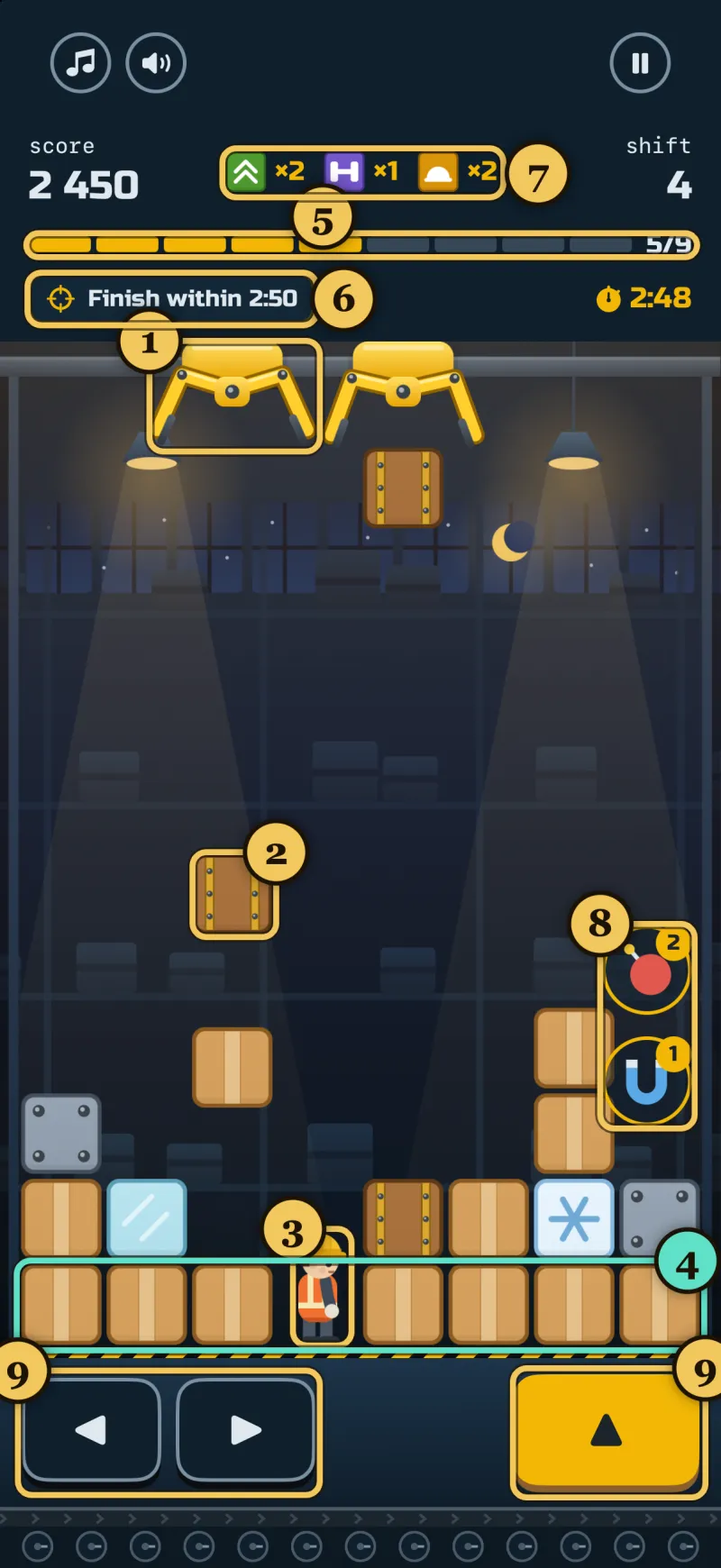
If the rules feel like a lot at first, the game’s own rules screen is a question-mark key on the title screen, and how to play shows every rule on a real screen. You do not need to learn them all at once: the first shift of every game is a regular one, with no twist.
Why people play them
People play casual games for different reasons, and none of them needs defending. Some want a pause between tasks. Some want something for their hands while they wait. Some like the small, clear satisfaction of a row cleared or a puzzle solved, which is easy to feel in under a minute. A casual game works best when it asks for as much attention as you have and gives something back either way.
This is also why short, replayable rounds suit the category. A round that ends in a minute or two lets you stop at a natural place, and the next one starts at once if you want it. A good casual game does not punish a short visit or reward a very long one.
Choosing a casual game
To pick a casual game that suits you, answer a few simple questions:
- How long do you have: thirty seconds, five minutes, or longer?
- Do you want to relax, or to be a little challenged?
- Do you mind interruptions, such as ads, between rounds?
- Will you play without a connection?
- Do you want a goal, such as a score or a streak, or just something to do with your hands?
Your answers point to a kind. Someone with thirty seconds and no wish for pressure may like a match game. Someone with five minutes and a taste for scores may like an arcade stacker. The page on games to play when you are bored has more ideas by mood.
Keeping it pleasant
A casual game is easy to overplay, because it is always one more round away. A few honest habits keep it fun: decide a number of rounds before you begin, stop on a good game rather than a bad one, and take a break if you notice you are tense. Nothing here is a health claim; it is just how pleasant things stay pleasant.
What does “casual” mean in games?
It means easy to start, quick to play and fine to put down. It says how a game fits your day, not how hard it is.
Can a casual game be hard?
Yes. Many have simple rules and a very high ceiling, so a beginner can start at once and an expert still has things to learn.