If you are looking for games like Tetris, Night Shift is one to try: things fall from above, you build full rows, and the rows disappear. The twist is that you do not steer the falling pieces. A crane drops single crates, and you play a small worker on the warehouse floor who walks, jumps and pushes them into place. Here is an honest comparison.
What it shares with Tetris
- Things fall, and you build rows. In Tetris you stack falling pieces to complete horizontal lines. In Night Shift a crane drops crates into eight columns, and a full bottom row ships out for points.
- A full row disappears. In both games the stacks above it drop down by one row, so a good move opens room for the next one.
- The pace builds. Each shift is a little faster than the last, with a quicker crane and quicker crates, and the music speeds up with it.
- It is a score chase. You play again to beat your best, and a speed multiplier rewards shipping rows quickly one after another.
What is different
In Tetris you do not control a character: you move and rotate the falling piece until it lands. In Night Shift there is nothing to rotate. Every crate is a single square, and the thing you steer is the worker. You walk left and right, jump up onto a stack, and walk into a crate to push it one column along. You can even walk into a crate that is still falling and knock it into the next column.
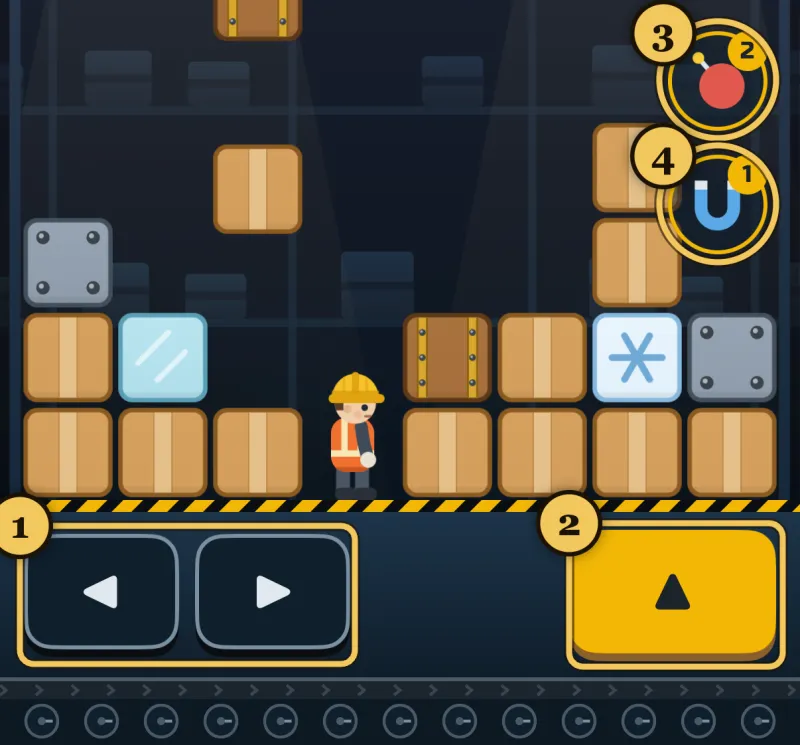
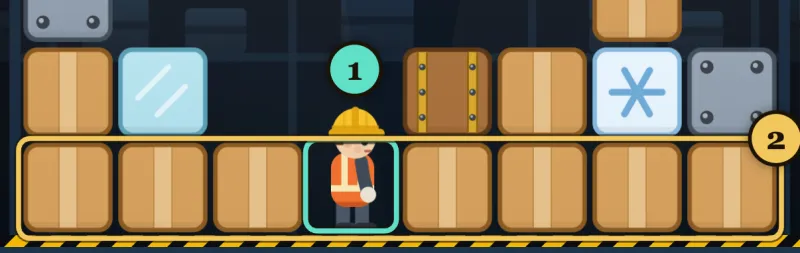
The second big difference is the rule for a full row. In Night Shift a row ships the moment each of the eight columns has a crate on the floor. It does not matter how tall the columns are or what the crates are made of. So you are not hunting for a perfect fit; you are making sure no column stays empty, and the worker often has to stand in the last gap and wait for a crate to land on the spot.
And you can lose in a way Tetris does not have. A game ends when a column grows ten crates high, or when a crate lands on your head and you have no helmet left. You start with one hat, and each hit takes it, so watching where the crates fall matters as much as where you put them.
| Tetris | Night Shift | |
|---|---|---|
| What falls | Pieces of four connected blocks, in seven shapes | Single crates of six kinds, plus rare pickups |
| What you control | The falling piece: move and rotate | A worker: walk, jump and push |
| A line clears when | A horizontal line is filled with blocks | Each of the eight columns has a crate on the floor |
| The game ends when | The pile blocks new pieces from entering | A column reaches ten crates, or a crate hits you without a helmet |
| Extras | Varies by version | Steel, glass, dynamite, ice, a bomb and a magnet, shifts with special rules |
Crates that bend the rules
Tetris pieces are all alike in how they behave. Night Shift crates are not. Steel is too heavy to push until you pick up strength, and it flattens cardboard when it lands. Glass breaks when another crate lands on it. Dynamite goes off when steel lands on it or a bomb reaches it. Ice keeps sliding once you push it. Valuable cargo pays 300 points when it ships. The crate guide has them all, and with them the game becomes less about fitting shapes and more about reading what is coming down.
Who will like it
- Players who enjoy the rhythm of stacking and clearing rows, and want something that asks for quick thinking and quick fingers at once.
- Anyone who has wished they could climb into the stack and push a piece with their own hands.
- Short sessions: a game can be put away when you pause, and the game plays offline, so it works on a commute or in a queue.
It may not suit you if what you love in Tetris is rotating pieces and fitting them perfectly. Night Shift has no rotation and no shapes to fit. It is more of an arcade game, where timing and position matter.
Try it
Night Shift is free to play on iPhone, iPad and Android. The ads are optional short videos you choose to watch, and coins and supply crates are optional in-app purchases. The rules fit on one page, and the tips help with the first late shifts. Questions about price, ads and offline play are in the FAQ.