A shift is a level of this puzzle game: a run of rows to ship, and each one is a little harder than the last. After the first, every shift also has a twist of its own and sets a task that pays more. This page lists how long a shift is, every kind of shift, every task, when the second crane comes out and how the pace builds.
How long a shift is
You sign a shift off by shipping its rows. The count is eight for the first three shifts, then one more for every three shifts, and never more than sixteen.
| Shifts | Rows to ship | Time for a "finish in time" task |
|---|---|---|
| 1–3 | 8 | 2:30 |
| 4–6 | 9 | 2:50 |
| 7–9 | 10 | 3:10 |
| 10–12 | 11 | 3:25 |
| 13–15 | 12 | 3:45 |
| 16–18 | 13 | 4:05 |
| 19–21 | 14 | 4:25 |
| 22–24 | 15 | 4:40 |
| 25 and on | 16 | 5:00 |
A 3-2-1 count-in starts every shift, and the progress bar at the top shows one block for every row you must ship. When the last row goes, the field stands still for a few seconds while the worker celebrates, then the card between shifts comes up.
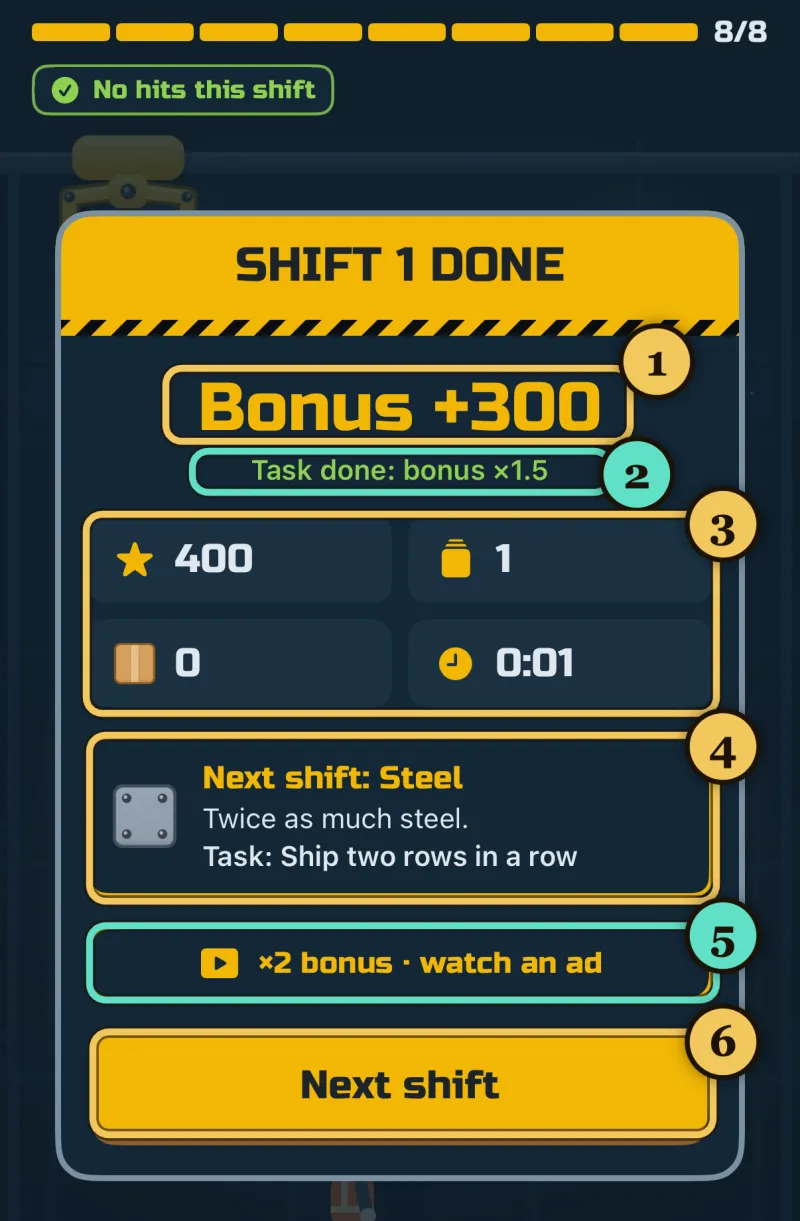
- The shift bonus.
- Task done: the bonus was multiplied by 1.5.
- The totals of the shift.
- The next shift's kind and task.
- The optional ×2 bonus (an ad).
- Start the next shift.
The kinds of shift
The first shift of every game is a Regular one. Each later shift draws one of the other five kinds, and never the same kind twice in a row. The card between shifts and the top panel always tell you which one you are in.
| Kind | What changes |
|---|---|
| Regular | No surprises. Only the first shift of a game. |
| Steel | Twice as much steel falls. |
| Dark | The lights fail far more often: the first power cut comes within about 15 seconds, and the next follows 15 to 25 seconds after the light returns. |
| Rush | A faster crane with less rest, and a double shift bonus. |
| Explosive | Far more dynamite comes down: about one crate in eleven. |
| Generous | Upgrades come down twice as often. |
Power cuts
From shift 2 on, the lamps fail now and then: a flicker as a warning, then about six seconds in which only a patch around the worker can be seen. In ordinary shifts the next cut follows 45 to 75 seconds after the light returns. Count-ins and the end of a shift always come back to the light.
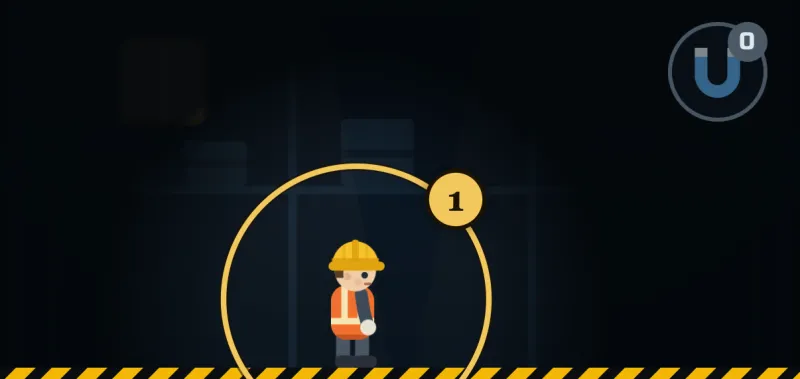
- The only part of the field you can see during a power cut.
The second crane
From shift 3, a second crane comes out and works alongside the first, with a "Second crane!" notice. Each crane rests longer when both are working, so the pressure grows without doubling. The crane goes off duty again when a new shift starts. When it comes out depends on the shift:
| Shifts | The second crane comes out |
|---|---|
| 1–2 | Not at all |
| 3–7 | Halfway through the rows |
| 8–14 | After a third of the rows |
| 15–19 | After a quarter of the rows |
| 20–29 | After a quarter, or from the very start of the shift if you reached shift 20 fast (about an hour and a half of play from shift 1) and without continuing a lost game |
| 30 and on | From the very start of the shift |
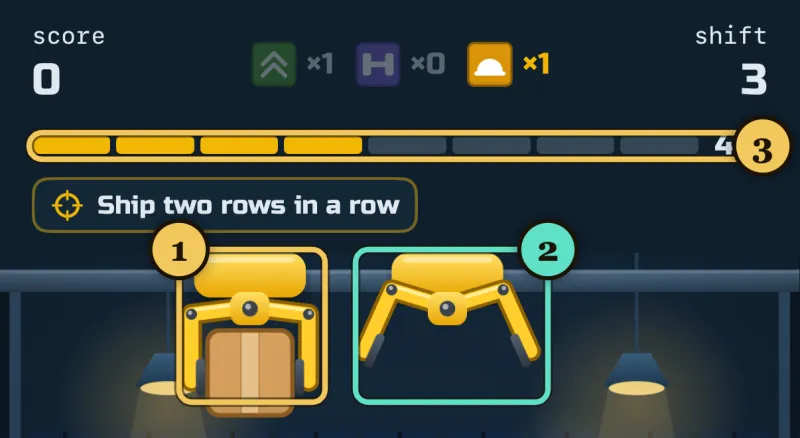
- The first crane, carrying a crate.
- The second crane, out for the second half of the shift.
- Four of eight rows shipped: the halfway point.
The pace
Everything gets faster with the shift: the crane moves faster, crates fall faster and the music speeds up. The rise is quick in the first shifts and flattens around shift 10; after that the pace grows five per cent a shift, up to double at shift 30. Inside every shift you start at about four fifths of that pace, and reach full speed halfway through the rows. If you would like a head start in practice, the settings let a new game start from any shift from 1 to 5 (the achievement for five shifts then does not count).
The three tasks
Each shift sets one optional task, drawn at random, and shows it on a tag under the progress bar. A target mark means it is open, a green tick means it is met and a red cross means it is lost. Meet it by the shift's last row and the shift bonus is half as big again.
| Task | How it is met |
|---|---|
| No hits this shift | You get through the shift without a crate landing on you. A hit that a helmet saves you from still counts as a hit, and so does a dynamite blast. |
| Finish within 2:30 | You ship the last row before the clock runs out. The time grows with the rows (see the table above) and counts only play time, not pauses. The countdown sits at the right of the top panel and turns red for the last 20 seconds. |
| Ship two rows in a row | At some point in the shift you ship a row within 8 seconds of the one before: two at once with a single crate counts too. |
Completing a "no hits" shift also earns the "Not a Scratch" achievement; see achievements. The bonus itself is explained in scoring.
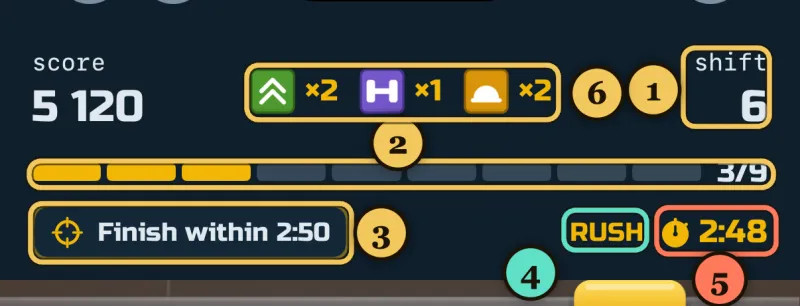
- The shift number.
- The rows shipped so far, out of the shift's nine.
- The task.
- The shift kind, in yellow.
- The time left for the task.
- Your upgrade counters.