The best relaxing games are not the ones with the softest colours. They are the ones that let you stop thinking about the clock, the score and what you might lose. This page sorts what actually calms in a game from what only looks calm, and says honestly where Night Shift, which speeds up as you go, fits in. The rules are short if you want to see for yourself.
What makes a game relaxing
Relaxation in a game rarely comes from the theme. A game about gardens can be stressful and a game about falling crates can be soothing, depending on how it treats you. Four things do most of the work.
- A rhythm you can fall into. Repeating the same small action (place, push, clear) with a steady beat lets your attention settle. Many people describe this as a flow state; you do not need the term, you will know the feeling when the next ten minutes disappear.
- Tidy results. A board that gets cleaner as you play, a row that vanishes, a pile that becomes level: finishing something small and visible feels like tidying a desk.
- Small stakes. If one mistake costs you an hour of progress, you play tense. If it costs you a few seconds, you stay loose.
- No demand to be elsewhere. A game that nags you, interrupts you or needs a connection is another thing to manage.
What does not relax, however pretty it looks
The opposite list is just as useful when you are choosing, because a store page will not warn you about it.
- Tight clocks. A countdown that ends your game makes every pause feel like a loss. Some people enjoy that; it is not relaxation.
- Punishing resets. Losing a long run to a single slip, with nothing kept, teaches you to play defensively and to dread the next try.
- Pressure to return. Appointment mechanics, flashing offers and streaks you must protect can turn a break into a chore. The page on the daily challenge shows how a streak works in Night Shift, and you can ignore it.
- Noise and surprise. Loud effects, sudden jump scares and interruptions between rounds make a quiet moment busy.
| Feature | Tends to calm | Tends to stress |
|---|---|---|
| Pace | Steady, or you set it | Speeds up without warning, or never lets you rest |
| Failure | Cheap, quickly retried | Expensive, loses a long run |
| Goal | Small and repeatable | Vague, or always one more unlock away |
| Interruptions | Pause and resume where you left off | Ads, pop-ups or timers that expire |
| Connection | Works offline | Needs a signal to start |
Kinds of game worth trying
No kind is relaxing for everyone, so treat these as starting points rather than promises.
- Sorting and tidying games. You put objects in order. There is a clear before and after, and nothing chases you.
- Slow puzzle games. Number grids, pipe and path puzzles, jigsaws. You set the pace entirely. They suit people who want a quiet mind rather than quick hands.
- Building and farming sims. Long, forgiving loops. Watch for timers that make you come back at set hours.
- Falling-block and stacking games. The rhythm is strong and the results are tidy, but most get faster. If you choose one, look for a game where a mistake is cheap.
- Exploration and walking games. No score, no fail state. Relaxing for some, boring for others.
One honest note on the list: a game that relaxes you at ten minutes can still wind you up at forty. If you notice your shoulders rising, that is your signal to stop, whatever the genre.
Where Night Shift fits, honestly
Night Shift is a stacking game with a crane, and it is not a slow one. Crates drop from the crane into eight columns, you walk, jump and push them into place, and every full bottom row ships out for points. Ship eight rows and the shift is done, with a bonus. Then the next shift starts, a little faster than the last.
So here is the fair description. In its favour: the rhythm of dropping, pushing and shipping is strong, a row disappearing is a satisfying small tidy-up, and there is no countdown that ends your game. What ends a game is a column ten crates high or a crate landing on you when you have no helmet left. The game is saved when you pause or leave it, and it plays fully offline, so nothing expires while you step away.
Against it: the crane does get faster, the music speeds up, and the later shifts add power cuts and a second crane. Some shifts also set an optional task, such as finishing within 2:30, but you can ignore it; it only changes the bonus. There is no pressure to return either, though the daily challenge is there if you want it. If you want a game that waits for you, pick something slower. If you want a gentle rhythm for the first shifts and a rising challenge afterwards, it can work as a wind-down, and the early shifts are the calm ones.
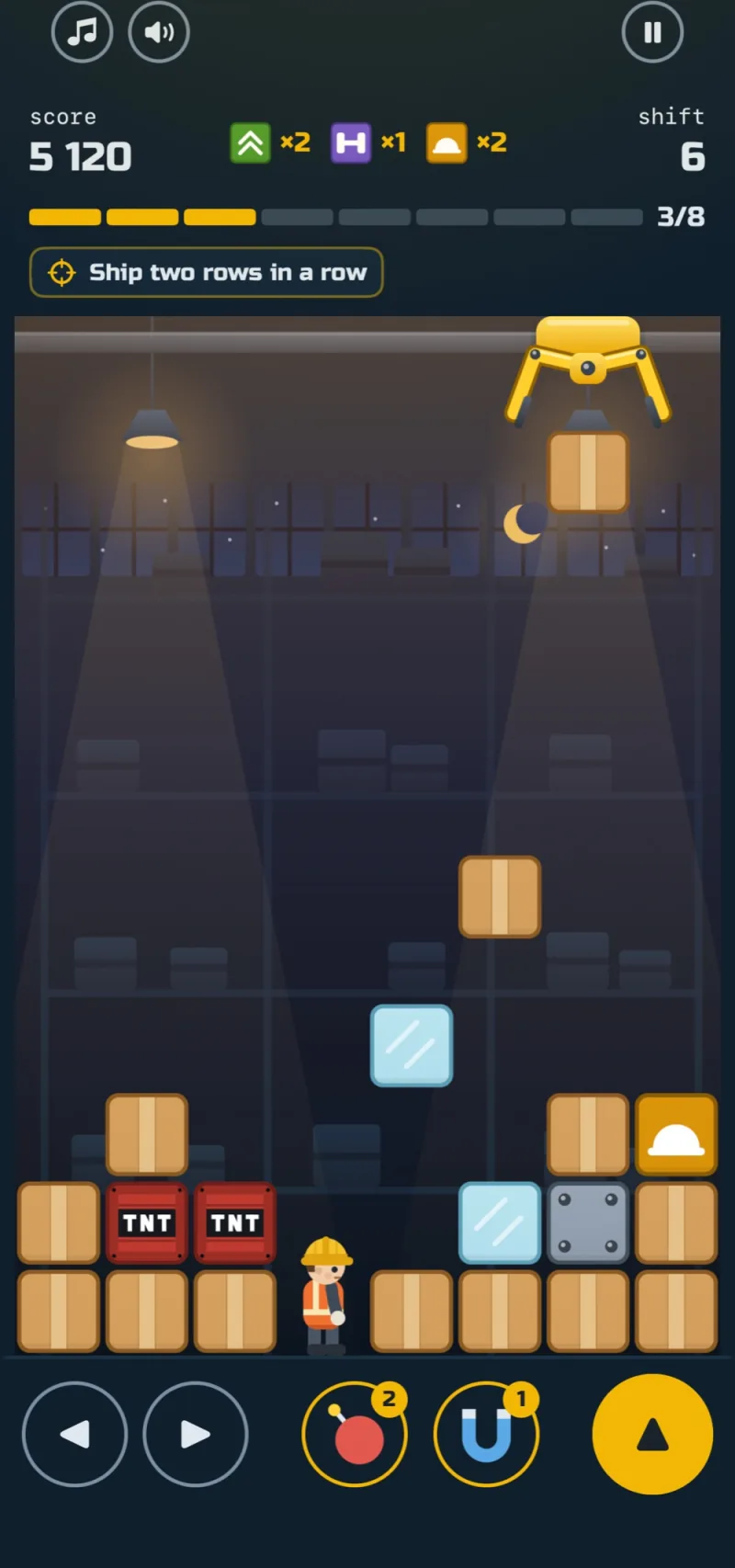
Two small settings help if you want it gentler. You can start a new game from shift 1 to 5 in the settings, so the first shifts stay the slow ones, and you can switch the sound and music off. The tips page also shows how to keep the floor tidy, which is most of staying calm.
A simple way to test any game
- Play five minutes with the sound as you would normally have it. Notice whether your breathing slows or tightens.
- Make a deliberate mistake and see what it costs. If it costs a lot, the game will make you tense sooner or later.
- Close the app mid-round and open it again. A relaxing game should be right where you left it.
- Go offline for a minute. If it refuses to start, expect interruptions later.
- Come back the next day. If it greets you with demands, it is a chore in disguise.
Relaxation is personal, and there is no study here to quote that says one genre wins. Use your own body as the judge, and treat any game as a pleasant break rather than a treatment.
Are puzzle games relaxing?
Many are, particularly ones with no clock and cheap mistakes. Fast ones can feel stressful even though they are puzzles. Judge by pace and by what a mistake costs.
Is Night Shift a relaxing game?
It has a calm rhythm and no countdown that ends the game, but it speeds up every shift. It suits a break more than a quiet evening of slow play.
Do relaxing games need to work offline?
It helps. A game that plays without a connection, such as Night Shift, will not interrupt you with loading or sign-in screens. Ads, the shop and leaderboards need a network, but are optional.
Related guides: scoring if you care about the numbers, and the FAQ for questions about ads and saving.