The right games to play when bored depend on two things: how many minutes you have and what kind of bored you are. This page matches kinds of game to both, so you spend the break playing instead of scrolling a store, and it names the kinds that make a short break worse.
First: how much time do you have?
Boredom comes in different sizes, and the biggest mistake is choosing a game for a longer slot than you have. A game that needs thirty minutes to get going is the wrong answer for a lift ride.
| Time | What fits | What does not |
|---|---|---|
| Two minutes | A timed arcade round, a single word puzzle, a quick logic cell | Anything with a long start-up or tutorial |
| Ten minutes | A shift or a level of an action puzzle, a few logic grids | Story games with long scenes |
| An hour | A longer puzzle campaign, a strategy game, a story chapter | A game with no saves |
Second: what kind of bored are you?
Restless: you want to move
If your mind is jumpy, pick an action game that fills your attention. Falling blocks, a runner or an action puzzle gives your hands and eyes something to do. Pick one with a short round, so that you can stop.
Flat: you want something to think about
If you feel empty, a thinking game fits better. A logic grid or a block-placing puzzle that waits for you lets you take your time. There is no clock to compete with.
Tired: you want little effort
When you are tired, avoid games that punish a slow response. A calm sorting or word game will do. This is also the moment when a game with a clear end is best, so you do not play on out of habit.
Lonely: you want something with others in it
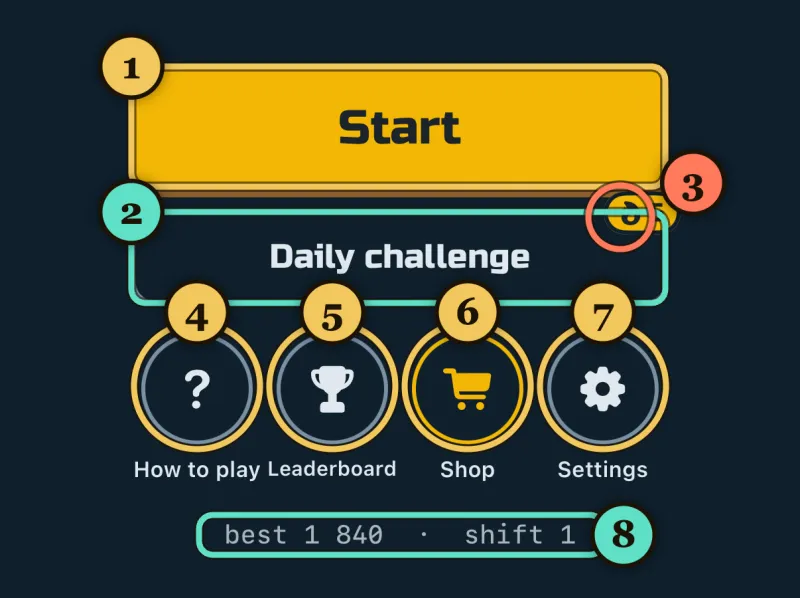
A game with a daily challenge gives you a shared task without any conversation. Everyone gets the same puzzle and compares scores, as in the daily challenge of Night Shift, where the crates are the same for everyone each day.
Quick picks by situation
- Waiting in a queue: a game you can start in one tap and put down in one tap.
- On a train without a signal: an offline game. See offline games.
- Before bed: a calm thinking game, not a fast one, which keeps you awake.
- At a desk, in a gap between tasks: something you can quit mid-round without losing a long run.
- A long evening: a game with progress, where the second hour feels different from the first.
What to avoid when you want a quick break
Some kinds of game turn a break into a time sink. Knowing them helps you pick.
- Games with energy timers. You get five minutes of play and then a wait, which leaves you bored again.
- Endless feeds with no end. There is no moment at which it is natural to stop.
- Games with forced ads after each round. The break becomes an advert with a game in it.
- Games that need a long tutorial. You wanted to play, not to read.
Thinking or reflexes?
A useful way to choose is to ask whether you want to feel clever or feel quick. Thinking games make you feel clever, slowly. Reflex games make you feel quick, at once. Action puzzles sit between them, and are a good compromise when you do not know which you want.
Night Shift is such a compromise. Each round is a shift of a few rows: you decide where crates should go, but the crane never waits. The game is saved when you pause, so a shift can be left when the break ends, and it plays offline. The rules fit on one page, how to play, and a first game needs nothing more than the arrow and jump keys.
A tip for the next boredom
Pick one game for each of the three slots above and keep them on the first screen of your phone. When boredom comes, you will not browse; you will play. Review the choice after a week, and replace the one you never opened.
If none of the moods above fits, try the one-round method: open the game you played last and play exactly one round. If you still want more, you chose well. If not, switch kind and try a different one for a single round. Two rounds cost less than five minutes and are a better guide than any list, including this one.
It also helps to notice what bored really means on a given day. Sometimes it is a wish for company, a snack or a walk, and no game will fix that. A game is the right answer when you want your attention held for a short while.
Questions people ask
Do I have to pay for a quick game?
No. Many good quick games are free and ask for money only for extras. Look for optional ads and optional purchases, which leave the choice to you.
How do I stop a short break turning into an hour?
Choose a game with natural stopping points, such as a level or a shift, and decide in advance to play one.