Arcade puzzle games sit where two old ideas meet: the arcade's love of scores, speed and one more try, and the puzzle's love of thinking before you act. This page explains what the overlap looks like, which mechanics define it, and what to look for when you choose one. It talks about mechanics rather than listing apps, and uses Night Shift as one worked example.
What the two halves bring
Arcade games came from machines that took coins, so they were built to be learned in a minute, to end quickly and to tempt you into another go. Puzzle games came from the pleasure of working something out. Put them together and you get a game with a short loop, a score to beat and a board you must read carefully.
| From the arcade | From the puzzle |
|---|---|
| A score to chase | A board you can read and plan |
| Speed that rises over time | Moves that reward thought over reflex |
| Short rounds, instant retry | Patterns you learn and reuse |
| Pressure and a risk of losing | A clear, fair set of rules |
The one-more-try loop
The defining feature of the genre is the loop. You start, you play for a few minutes, you lose or finish, you see your score, and you feel sure you can do better. Three design choices make that loop work.
- Losing is quick and clear. You know exactly what went wrong: a column too tall, a move that trapped you. A death you understand is an invitation, not an insult.
- Restart is instant. Every second of menus is a second to change your mind.
- Progress is visible. A best score, a shift number or a leaderboard puts a figure on your improvement.
The same loop can go sour. If a game puts a long wait, an ad or a purchase prompt between rounds, the loop breaks. Look at what happens after a loss.
Rising speed, with thinking rather than aiming
Most arcade puzzle games get faster, which is the pressure that turns a puzzle into a game. The question is what the speed asks of you. In a shooter it asks for aim and reflex. In an arcade puzzle it asks for decisions: faster pieces mean fewer seconds to choose, so the skill is seeing the board quickly and keeping it tidy so that choices stay easy.
A fair arcade puzzle also gives you a way to build skill. Early levels are slow enough to practise on; later ones add rule changes. The best ones let you see what is coming next, so a good player is the one who plans, not only the one with fast thumbs. For more on balancing the two, see action puzzle games.
Mechanics to look for
- Combos and multipliers. Clearing several things in a row pays more. This rewards planning ahead.
- Special pieces. Items with their own rules, such as a bomb or a magnet, add decisions.
- Rule-changing stages. Occasional twists keep a long game from going flat.
- Daily or shared challenges. The same puzzle for everyone makes scores comparable.
- A fair fail state. Losing because of a clear mistake feels better than losing to a random event.
Night Shift as an arcade puzzle
In Night Shift, a crane drops crates into eight columns, you walk, jump and push them into place, and every full bottom row ships out for points. Ship eight rows to finish a shift and collect a bonus; the next shift is a little faster. Here is how it matches the list above.
- Score chase: the game keeps your best score, and finished games go to a leaderboard through Game Center on iPhone and iPad or Google Play Games on Android. Those need a connection; playing does not.
- Multiplier: ship a second row within 8 seconds of the first and the multiplier rises from ×1 to ×5. Five rows in quick succession give 1,500 points, three times the same rows shipped slowly. The scoring guide has the table.
- Special pieces: a helmet, a jump, strength, a bomb and a magnet, found as rare pickups, see upgrades.
- Rule-changing stages: shifts with more steel, a rush, a dark warehouse, extra dynamite or generous upgrades, plus optional tasks. See shifts and tasks.
- Shared challenge: the daily challenge gives everyone the same run of crates, once a day.
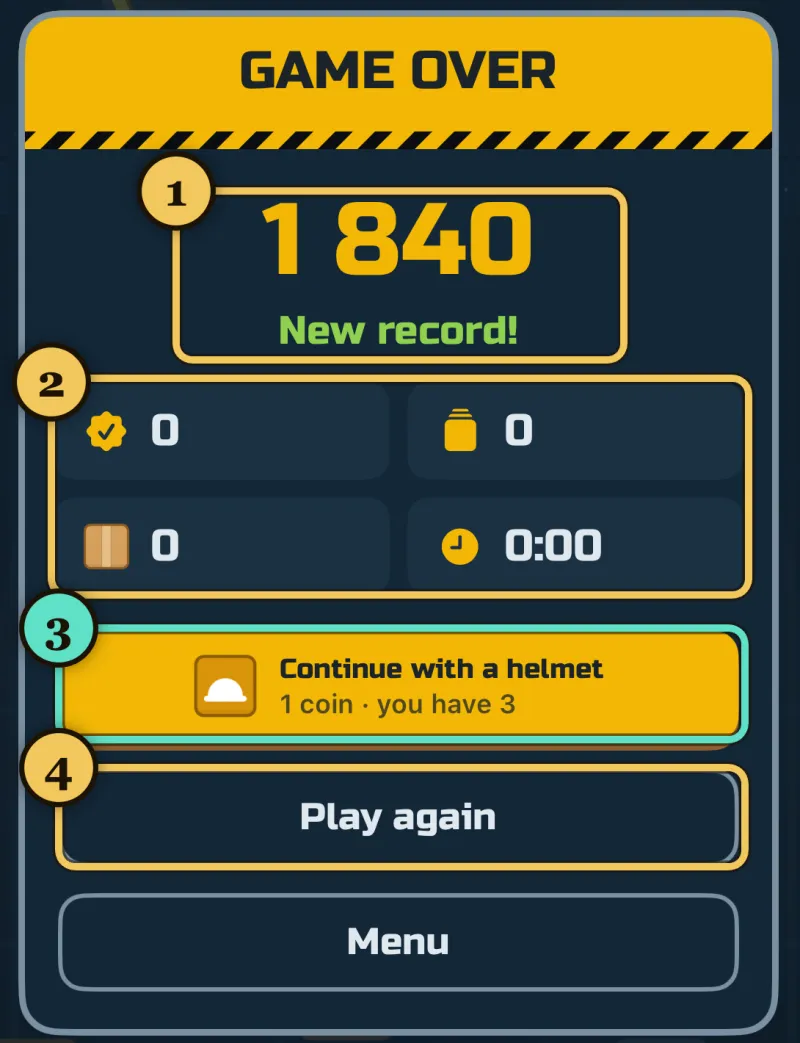
What it asks of you is thinking more than aiming. You look for the lowest column, keep the floor flat, and dodge the crane's drop. The speed rises, but there is no countdown that ends a game. What ends it is a column ten crates tall or a crate on your head when you have no helmet.
One honest caveat concerns the loop. After a loss, the game-over card offers a continue with a helmet, which costs coins or a short optional ad. You may ignore it and start again at once. Ads are only optional videos for a reward, and coins and supply crates are optional in-app purchases.
How to choose one
- Play the first five minutes and see whether you understand why you lost.
- Check how quickly you can retry.
- See whether the speed rises gently or in jumps.
- Look for ways to practise, such as starting from a later stage. Night Shift allows a starting shift from 1 to 5 in the settings.
- Check what the game asks for after a loss, and whether it works offline.
Nothing here says one genre is better for you than another, and there is no study to quote. They are simply a pleasant way to pass a short break. The page on high score games goes further into the chase.
Are arcade puzzle and action puzzle the same?
They overlap a lot. Arcade puzzle stresses scores and the retry loop; action puzzle stresses thinking in real time. Many games are both.
Do arcade puzzle games work offline?
Many do. Night Shift plays offline; ads, the shop and leaderboards need a connection.
Does Night Shift show ads between rounds?
No. The only ads are optional reward videos: to continue, for a free daily coin and for the ×2 shift bonus.