High score games reward a single number, and the way to beat your best is rarely to play faster; it is to understand where the points come from, what risk is worth taking, and when to play safe. This page explains multipliers, the trade between risk and safety, and how leaderboards change the way you play, using Night Shift’s scoring as the worked example.
Where the points come from
Before chasing a score, find out where the points come from. In most arcade games there are three sources: a base reward for the main action, a multiplier that rewards doing it again quickly, and small bonuses for clever extras. Players who treat all points as equal waste effort on the small ones.
In Night Shift the base action is shipping a row, which scores 100 points times a multiplier. The multiplier starts at ×1 and goes up by one each time you ship another row within 8 seconds of the last, to a top of ×5. Wait longer than 8 seconds and it falls back to ×1. Only time spent playing counts, not pauses or the count-in.
| Rows in a quick chain | Points for the latest | Chain total |
|---|---|---|
| 1 | 100 | 100 |
| 2 | 200 | 300 |
| 3 | 300 | 600 |
| 4 | 400 | 1,000 |
| 5 | 500 | 1,500 |
What a multiplier changes
A multiplier changes what a good move is. Without one, you simply do the safest useful thing. With one, tempo becomes part of the score, and waiting for a perfect setup can cost more than a rough move made now. The trick is to build so that the next reward is already close when the last one lands. In Night Shift that means building the second layer while you wait for the last gap of the first; when the bottom row ships, the row above drops, and if it is already full it ships straight after.
Risk against safety
Every high score game has a place where you choose between a safe move and a profitable one. Naming the risk beforehand makes the choice easier. Ask what you lose if it goes wrong, how likely it is, and whether you could recover.
- Valuable cargo pays 300 points on top of a row, but steel that lands on it and any blast destroys it. The safe play is to ship it soon; the greedy one is to leave it for a bigger row.
- Dynamite chains score 5 points for every crate destroyed and earn achievements, but the blast hurts you if you stand inside it. Set it off from afar with a bomb.
- A hit costs a helmet, plus your jump and strength upgrades. Saving points by a risky dodge is usually a bad trade.
A good rule is to take risks when the downside is small and recoverable, and to be careful when one mistake would end the run.
When to cash out
“Cash out” means stopping a risky build and taking what you have. In this game it is shipping the row now instead of waiting for a better one. If the multiplier is about to expire and a row can be completed in a couple of moves, take it. If a chain would need three more crates that are not here yet, let it go, because the multiplier falls back to ×1 anyway when you wait too long.
The shift bonus takes over
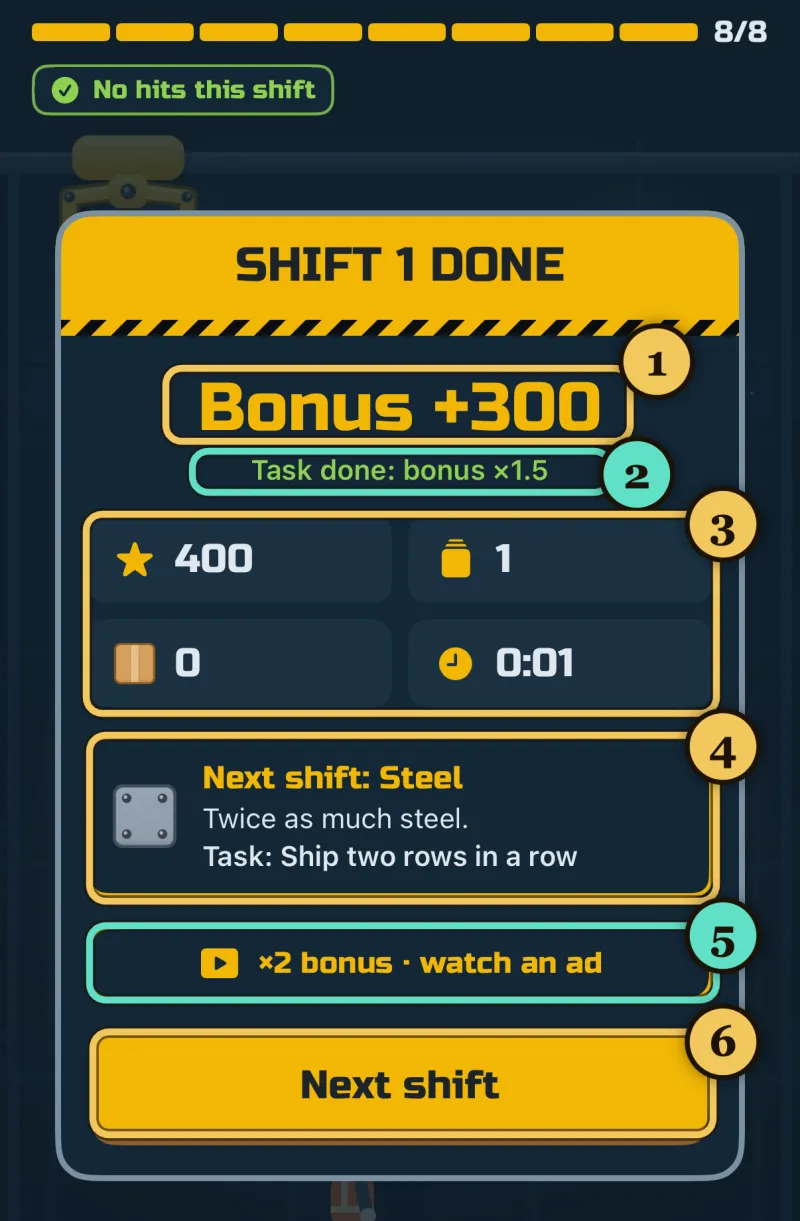
Later in a game, the shift bonus outgrows the rows. When you ship a shift’s last row you are paid 25 points times the shift number times the rows that shift needed. A Rush shift pays double, and meeting the shift’s task makes the bonus half as big again.
| Shift | Rows | Bonus | With the task done |
|---|---|---|---|
| 1 | 8 | 200 | 300 |
| 10 | 11 | 2,750 | 4,125 |
| 20 | 14 | 7,000 | 10,500 |
| 30 | 16 | 12,000 | 18,000 |
So the plan changes as the game goes on: early on, chase multipliers; later, protect the run, because getting through the shift with the task done is worth more than a few extra rows. The game also has an optional ×2 bonus ad on the card between shifts; the daily challenge does not offer it.
Leaderboards and milestones
A leaderboard shifts your attention from your own best to other people’s. That can be motivating, but it can also make you play recklessly. A sensible way to use it is as a map: look at a score just above yours and ask which part of the game could produce it. In Night Shift there are two boards, an all-time one and a daily one that starts afresh each day for the daily challenge. They work through Game Center on iPhone and iPad and Google Play Games on Android, need a connection and a signed-in player, and the game keeps your best score on the device without them.
The game also marks milestones as achievements: 10,000, 50,000 and 100,000 points in one game. They make useful stepping stones. The list is in the achievements guide.
A routine for beating your best
- Play a game with no goal except to see where your points come from.
- Look at your last game: how many rows were quick, and how many were slow?
- Pick one change, such as building two layers, and play three games with it.
- Only then add risk: cargo, chains, quick dodges.
The scoring guide has every number, and the tips page turns them into habits.
Is playing faster the way to a higher score?
Only if you stay safe. A multiplier rewards quick, clean rows, but a hit costs more than speed gains.
Does continuing a lost game keep my score?
Yes. Continuing keeps your score and shift, and the “New record” line is checked again when the game ends for good.