Daily challenge games give every player the same puzzle or run on the same day, so your result can be compared with anyone else’s. That one idea explains why a shared daily run feels fair, why it makes a short habit easy, and what separates a good daily design from one that just nags you. Here is what to look for, and how Night Shift handles it.
What a daily challenge is
A daily challenge is a single run or puzzle that changes every day and is the same for everyone who plays that day. Word games use the idea with a hidden word, puzzle games with a fixed grid, and arcade games with a fixed series of events. Because the starting point is shared, a score or time means something: whoever did better solved the same problem better.
Why a shared run is fair
Luck is the usual complaint about arcade scores. If one player gets an easy drop of pieces and another a cruel one, a leaderboard measures dice, not play. A daily challenge removes most of that by using one seed for the day. Everyone meets the same events in the same order. What differs is what each player does with them.
A shared run also gives you something to talk about. “The second shift was nasty today” is a conversation you can only have when everyone played the same thing. And it makes losing easier to take, because the problem was the same for everyone else too.
What a good daily design needs
Not every daily mode is well made. When you judge one, check these points:
- The same start for everyone. A daily that changes depending on how well you did earlier is a personal difficulty setting, not a shared challenge.
- A clear limit on attempts or a clear rule about what counts. Otherwise the best score belongs to whoever has the most free time.
- No purchases that tilt the result. If paid items change the outcome, the board compares wallets as much as skill.
- A forgiving streak. Missing one day should cost a small amount, not wipe out weeks of effort.
- No pressure to open the game every day. A reminder you can switch off is fine; a reminder that cannot be switched off is not.
Building a habit without a grind
A streak, the count of days in a row, is the usual hook. It works because losing a long streak feels worse than the effort of keeping one. Used honestly, it is a gentle nudge to play for a few minutes each day. Used badly, it is a way to make you feel guilty. A good test is whether you would still play on a day when the streak did not matter.
Three small ideas help keep a daily habit without a grind. Tie it to something you already do, such as the first coffee or the commute. Keep it short enough that you cannot say you had no time. And decide in advance that a missed day is not a failure.
How Night Shift does it
Night Shift has a daily challenge on the title screen. It is played with the same dice for everyone on the same date: the same run of crates, the same kinds of shift and the same tasks, always from shift 1. To keep it fair, supplies bought from the shop are not used in it, there is no continue after a game over, and the ×2 bonus ad is not offered. Crates that fall from the crane, including upgrades, work as usual. There is a daily leaderboard that starts afresh every day, next to the all-time one.
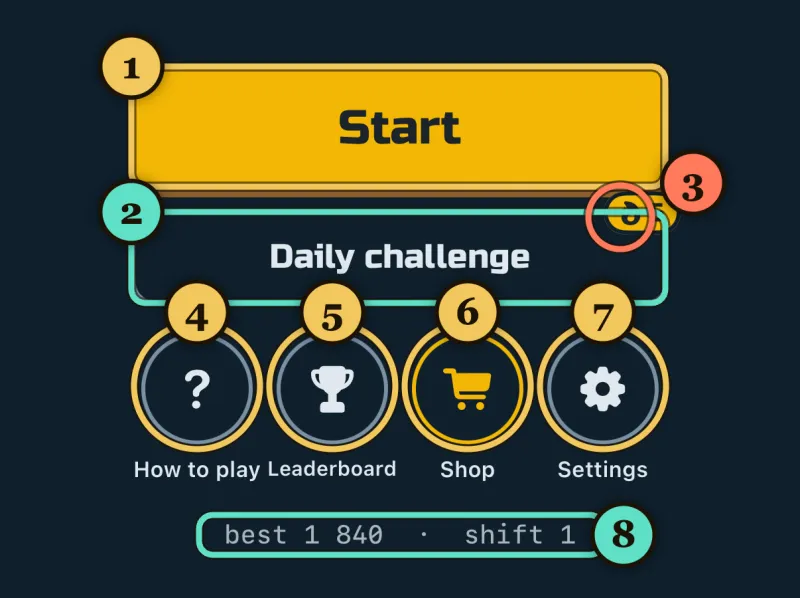
The streak counts a challenge played to its game-over, and only the first of each calendar day counts, however many times you play. If the last counted day was yesterday, the streak goes up by one; after a longer gap it starts again at one. Every seventh day in a row pays one coin. A game that ends early still counts, so a day with only a couple of minutes is not lost. The full rules, including the optional reminder at 19:00, are in the daily challenge guide.
Playing a shared run well
Because the setup is shared, the difference is in the decisions. A few habits help on any day:
- Read the next shift’s task on the card between shifts and plan the first minute around it.
- Do not count on shop supplies; the helmets the crane drops are the ones you have.
- Keep the stacks low. A shared run is no kinder than a normal one, and losing a hat costs your jump and strength too.
- Play a short game rather than skip the day, because a lost game counts for the streak just as much as a long one.
More general advice for scoring in games like this is on high score games, and the idea of consecutive days is explored in the page on streak games.
Is the daily challenge really the same for everyone?
Everyone who plays on the same date gets the same run of crates, shift kinds and tasks. What you do with them decides your score.
What happens if I miss a day?
After a gap of more than a day, the streak starts again at one. Your best scores and everything else are kept.