Streak games reward you for coming back day after day, and a streak can be a pleasant habit or a quiet source of pressure. This page explains how streaks motivate, where they turn into a chore, what a forgiving design looks like, and how to keep your own streak sane. Night Shift has one in its daily challenge, so it is described plainly as an example.
How a streak works on you
A streak counts consecutive days on which you did one small thing. The number grows, and it becomes something you own. Three ideas from everyday psychology explain why it works, without any need for studies to back it up.
- A visible number. Seeing "12" is more concrete than "I have played lately".
- Loss feels bigger than gain. Once a streak is long, the thought of resetting it to zero weighs more than the pleasure of extending it.
- A cue. A daily event gives you a habit trigger: with your coffee, on the bus, before bed.
These are common sense observations, not findings from a particular experiment. They are enough to see why designers like streaks and why they can be a mixed blessing.
When a streak helps
- It gives a reason to start when you would otherwise not. Ten minutes later you are glad you did.
- It turns a game into a small routine, a pleasant fixed point in the day.
- It rewards showing up, not winning. A bad game counts as much as a good one.
- It can be ignored without punishment, if the game is designed well.
When it turns into pressure
- The streak becomes the point. You play when you are tired or busy, not because you want to, but because you would hate to lose it.
- Travel and illness break it. A long streak ends on a day when you had better things to do.
- Notifications nag. A reminder at the wrong time makes a game feel like a chore.
- It can be bought back. Streak repair for money turns your worry into revenue. Check whether a game does this.
- All-or-nothing. One missed day wipes the number. This is the harshest design.
| Design choice | Forgiving | Harsh |
|---|---|---|
| A missed day | A grace day, or the streak only pauses | Back to zero at once |
| Reward | Small, regular, optional | Big bonuses that you lose if you break it |
| Reminder | Off by default, easy to turn off | Constant and hard to silence |
| Repair | Not sold, or earned by play | Sold for money |
| Effort per day | One short session | A long task to qualify |
How the Night Shift streak works
Night Shift is a stacking game: a crane drops crates, you push them into place, and full bottom rows ship for points. Its streak belongs to the daily challenge, a challenge available once a day that gives everyone the same run of crates, shift kinds and tasks.
- Finishing a daily challenge, which means playing it to its game-over, counts for the day. A lost game counts as much as a long one.
- Only the first challenge of each calendar day counts for the streak, however many times you play.
- If the last counted day was yesterday, the streak goes up by one. After any longer gap, it starts again at one.
- Every seventh day in a row pays one coin, which you can spend on continuing a lost game.
- Leaving a challenge from the pause card does not count.
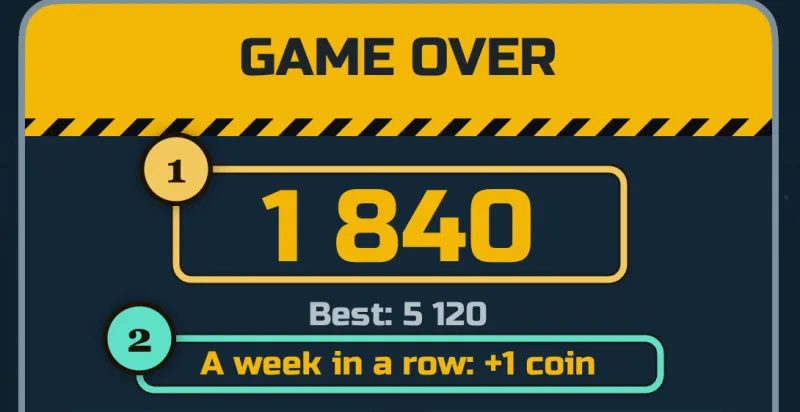
In the terms of the table above, it is a mixed design, and I will say plainly which parts. Gentle: one short session qualifies, a lost game counts, the reward is small, nothing is sold to repair the streak and the daily reminder is a choice you can switch off in the settings. Strict: there is no grace day, so a missed day resets it to one. Its details are on the page about the daily challenge.
Two other honest points. The challenge plays offline, so travel does not stop it, though the leaderboard and ads need a connection. And the coin is useful but not essential: the game says everything can be earned by playing.
Keeping your own streak sane
- Ask what you want from the game. If it is fun, play for fun. If you notice you play from fear, loosen your grip.
- Pick a time that is already free. Attach it to something you do anyway.
- Keep the minimum tiny. In Night Shift a short, even losing, game counts. Do not wait for a perfect session.
- Switch off reminders that annoy you. Your phone also lets you silence a game altogether.
- Let a streak die once on purpose. The world does not end, and a lower number is often a relief.
- Do not pay to repair one. If a game sells streak repair, treat it as a warning.
Your streak is a toy, not a score of your character. If it helps you play more happily, keep it; if it makes you play less happily, drop it.
What happens if I miss a day in Night Shift?
The streak starts again at one the next time you finish a daily challenge. There is no grace day.
Does a lost game count for the streak?
Yes. The streak counts at a game-over, so a lost game counts as much as a long one. Leaving from the pause card does not count.
Can I buy back a streak?
No. The game does not sell streak repair. A streak pays one coin every seventh day.
See also the achievements, two of which belong to the daily challenge.