Classic arcade games were built for a coin and three minutes, and that design pressure produced a set of ideas that still work: rules you learn in a glance, difficulty that rises, and a score that begs for one more try. This page tells the golden age in short, names the ideas that came out of it and shows why they fit a phone.
The golden age in short
The arcade golden age is usually placed between the late 1970s and the early 1980s, though historians differ on the exact years. A common starting point is Space Invaders in 1978. It was followed by Asteroids in 1979, Pac-Man in 1980 and Donkey Kong in 1981. By about 1983 arcade revenue in North America was falling, as home consoles spread and the market filled with copies.
It was an unusual time for design. The machines were slow, the memory tiny, and the player paid by the play. Designers could not rely on length, cut scenes or a story. They had to make the first ten seconds clear and every following minute worth another coin.
The design ideas that came out of it
Rules you learn in seconds
You walked up to a machine you had never seen, watched somebody else for half a minute and then played. So the controls were few: a stick and a button or two. The goal was visible on the screen. Everything the player needed was shown, not explained.
Difficulty that rises by itself
Space Invaders is often credited with a format that stayed: waves that get harder, with a limited supply of lives. The shift from level to level was the reward. Each wave was a little faster or more crowded than the last, so that a skilled player always met a new test and an average one eventually lost.
One more try
A run was short enough that losing felt like your fault and not the machine's. You had seen what killed you, and you could see how to avoid it next time. That feeling of nearly is the engine of the genre: not to win, but to improve by a little.
The high-score table
Scores were kept on the machine, and some games, Asteroids among the first, let the best players enter their initials. A table of names is a public record, and it turns a private game into a quiet contest with strangers. The rank of three initials on a cabinet could last for months.
| Idea | What it gave the player | Where you see it today |
|---|---|---|
| Few controls, clear goal | Instant start | Almost every puzzle game on a phone |
| Rising speed | A reason to get better | Endless runners, falling-block games |
| Lives or a single hit | Real stakes | Games with a game over |
| High-score table | A target and a rival | Leaderboards |
| Short runs | Play in minutes | Phone sessions between tasks |
Why they suit a phone
A phone is the arcade again: you have a few minutes, you are standing up or waiting, and you want something that starts at once. Games that need a manual do not work there. Games that were designed to be understood in a glance do, which is why so many popular phone games are arcade games underneath.
The modern difference is that there is no coin. Free games must earn their money in other ways, and the honest ones ask for it only when you want to carry on. Their question is the arcade's old one: continue, yes or no?
Arcade ideas in Night Shift
Night Shift is a modern game built on those old principles. A crane drops crates into eight columns, and you shape them into rows that ship out for points. A shift is a fixed number of rows, eight to begin with and rising to sixteen, and each shift is faster than the last: the crane, the falling crates and the music all speed up. The game ends when a column reaches ten crates or a crate hits you with no helmet left.
The score rewards speed in exactly the arcade way. Each row scores 100 times a multiplier that rises with every row shipped within eight seconds of the last, up to five. The scoring guide has every figure. The best score is kept on the title screen and sent to a leaderboard: Game Center on iPhone and iPad, Google Play Games on Android. There is also a daily challenge with the same crates for everyone each day, which gives a table to compare against, as an arcade high-score board did; see the daily challenge guide.
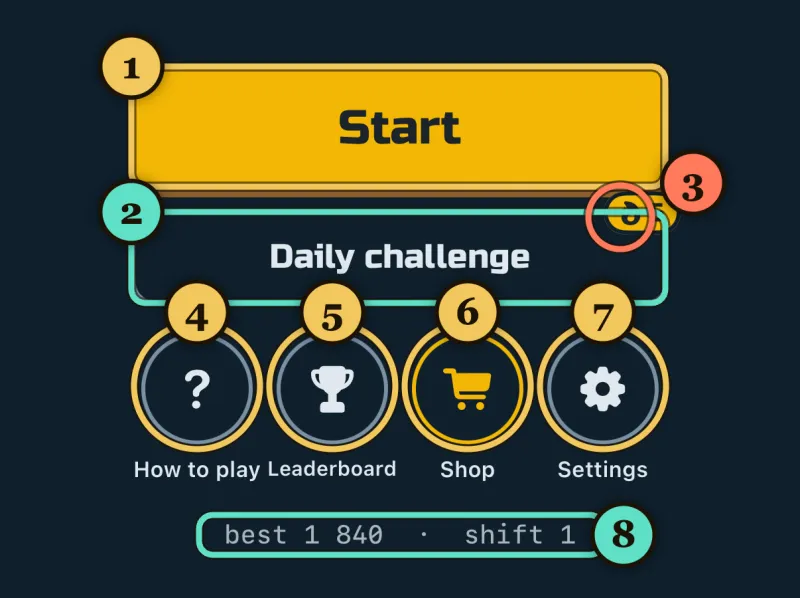
What is new is the continue. An arcade game asked for another coin. Night Shift offers to continue with a fresh helmet for a coin or a short ad you choose to watch, and you can decline both.
What the golden age did not do
It is easy to romanticise the era. Many machines were unforgiving by design, so that the average player lost quickly and paid again. Modern design can keep the clarity and drop the cruelty: the best new arcade-style games keep what was good in the old ones, which is the immediacy, and let you stop and start without a penalty.
Questions people ask
Why do old arcade games still feel good?
Because they were designed around a few clear actions and a fast cycle of try, fail and try again. Those qualities do not date.
Where can I play something in that spirit now?
Look for games with simple rules, rising speed and a score. Night Shift is one such game, on iPhone, iPad and Android.