Pixel art games are games drawn from individual, visible pixels, and the look began as a limit of old hardware but has become a deliberate style. This page explains what pixel art is, why small sprites and fixed palettes make pictures that read clearly, and what to look for in a pixel art game that is more than a retro costume.
What pixel art is
Pixel art is digital art in which each pixel is placed on purpose. A low-resolution photograph is not pixel art; a sprite whose every dot was chosen by an artist is. The image is built from the smallest unit a screen has, and the artist works with that unit as a painter works with a brushstroke.
The style grew out of the arcade machines and early home consoles of the late 1970s and the 1980s, whose memory and screen resolution were small and whose colours were limited to a fixed palette. Artists drew characters in a grid only a few dozen pixels across, and learned to suggest a face with two dots. The term pixel art itself was used in print in 1982, though the practice is older.
A limit that became a style
For a long time the look was simply what the hardware could do. Later hardware could show millions of colours, yet many artists kept the old grid by choice. They had found that the constraints gave their work something that detail did not: clarity, charm and a clear visual identity. That is the difference between a limit and a style: a limit is forced, a style is chosen.
There is a second reason. Small sprites are cheap to make, so a small team can finish a whole game. Pixel art lets one or two people produce a complete, consistent look, which is why it is common in independent games.
What makes pixel art read well
- A strong silhouette. A character is recognisable from its outline alone. If you filled it with black, you would still know who it is.
- A small, fixed palette. Limiting colours keeps the picture calm and lets each colour carry a meaning: red is danger, yellow is a pickup.
- Clean pixels. Edges follow the grid, with no half-blurred lines. Mixed pixel sizes in one picture look like an error.
- Contrast between layers. The thing you control, the thing that hurts you and the background should be separable at a glance.
- Motion in few frames. A walk cycle of four frames can look alive if the timing is right.
Pixel art in a puzzle game
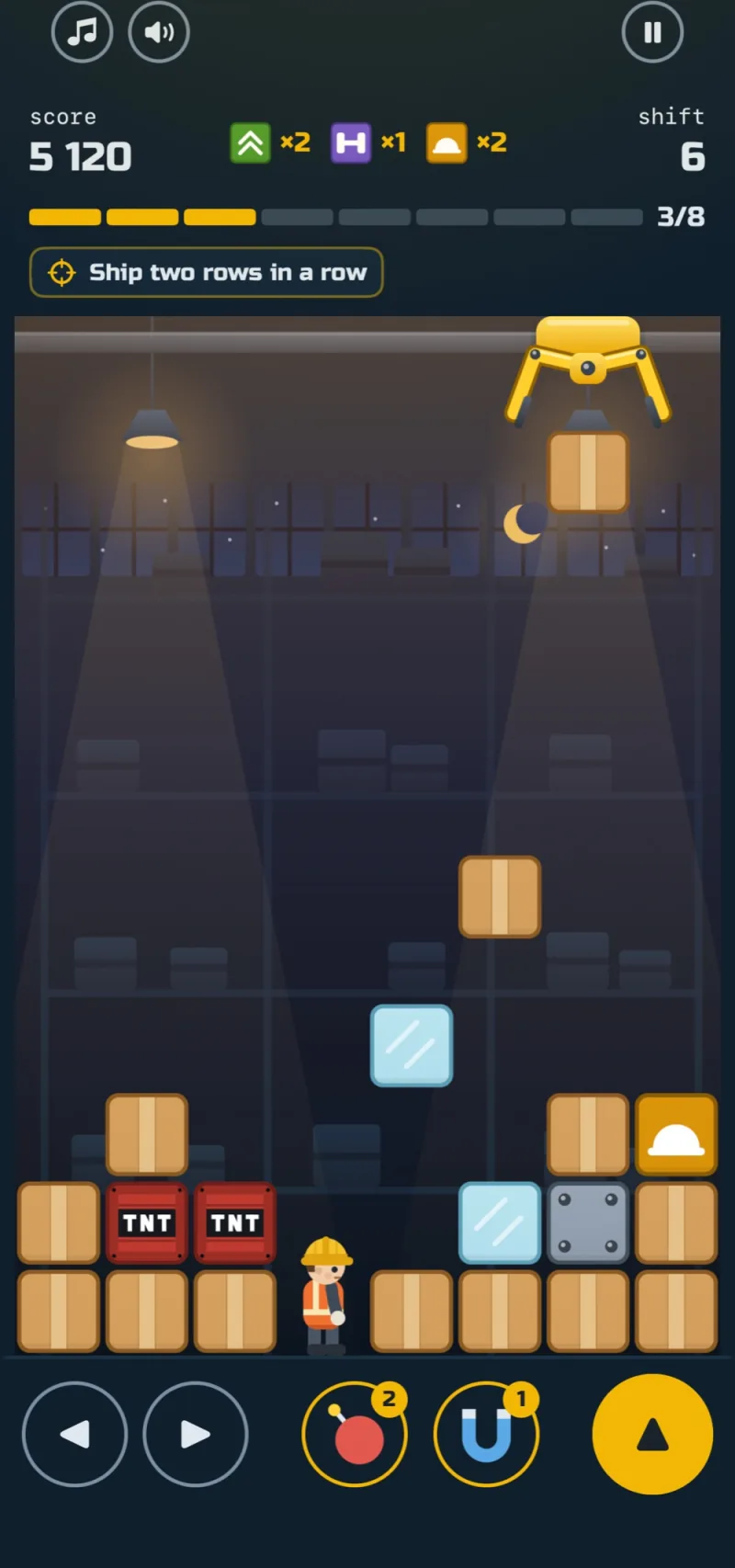
Puzzle and arcade games suit pixel art particularly well, because a puzzle needs the player to read the board instantly. In a grid of crates, you must tell steel from cardboard at a glance and know where the danger is before it lands. Simple shapes and flat colours do that better than detailed rendering.
Night Shift is drawn in a retro pixel style. Its crates are six clear shapes in distinct colours: cardboard, steel, glass, dynamite, ice and a green crate with a diamond for valuable cargo. The five upgrades are coloured crates of their own, yellow for the helmet, green for the jump spring, purple for the strength glove, red for the bomb and blue for the magnet. You can see all of them in the crates guide and the upgrades guide.
What to look for in a pixel art game
- Look at the screenshots at actual size. If it is hard to tell what is what in a still, it will be harder in motion.
- See whether the pixels are consistent. One pixel size throughout is the sign of care.
- Check that colour carries information. Good games give each colour a job.
- Watch a short video for animation. Four to six frames per action is enough when well timed.
- Check whether the style helps the game. If the art is a costume over a generic game, it will not hold your interest.
| Style | Strength | Weakness |
|---|---|---|
| Pixel art | Clear at small sizes, charming, cheap to produce | Can look samey when copied without care |
| Flat vector shapes | Sharp at any size | Can feel cold |
| Detailed 3D | Rich, realistic | Costly; hard to read on a small screen |
Pixel art and nostalgia
Pixel art is often described as nostalgic, and for many players that is true: it recalls the first games they played. But nostalgia is not the whole case for it. Many people who never saw an arcade enjoy it for the same reasons as everybody else: it is readable, it is warm and it lets the game be about play. You can follow the thread on to classic arcade games, the other half of the retro story.
Questions people ask
Is pixel art the same as 8-bit?
Not exactly. 8-bit names the hardware of an era, while pixel art is the drawing technique. A modern game can use pixel art with far more colours than an 8-bit machine allowed.
Is pixel art easier to make than other art?
Each sprite is small, but making it read well is a skill. Small size makes it quick to produce and unforgiving to get wrong.