Action puzzle games ask you to think while the clock, or the crane, keeps moving. Instead of taking as long as you like over a move, you plan, act and re-plan in seconds. This page explains what the label means, where it comes from in falling-block and arcade games, and how to balance speed and planning, with Night Shift as a worked example.
What "action puzzle" means
A pure puzzle game waits for you. A pure action game tests reflexes. An action puzzle game sits between them: there is a problem to solve, such as fitting shapes, clearing a grid or ordering objects, but the problem keeps changing in real time, so you must solve it under pressure.
The easiest test is this: if you can put the phone down for a minute and nothing changes, it is a puzzle game. If the board moves on without you, it is an action puzzle. Plenty of games sit on the border, and no official list decides, so treat the label as a description, not a category with strict edges.
Where the idea comes from
The best-known ancestor is the falling-block game. Tetris, created by Alexey Pajitnov in Moscow in 1984, gave the world a loop that is still copied: a piece falls, you decide where it goes, the board fills, and a good placement clears space. Its pieces are the puzzle; the falling is the action. Many later games follow the same shape with new pieces, such as coloured blobs, gems or crates.
Arcade games added the other half. They taught players to read patterns quickly, to keep going for a score and to try again right away. Combine the two and you get the action puzzle: the planning of a puzzle, the tempo and score chase of an arcade game. The page on arcade puzzle games looks at that overlap in more detail.
The balance between speed and planning
Every action puzzle asks the same question: how much of your time should go to thinking, and how much to doing? The answer changes as the game speeds up. Here are habits that work in most of them.
- Decide before the piece arrives. If you can see what comes next, use the seconds before it lands to choose where it goes. Thinking after it lands is too late.
- Keep the board flat and open. A tidy board gives you more options, and options are what buy you time later.
- Do the safe move first. Under pressure, a reliable small gain beats a risky large one. Save risks for when you are comfortable.
- Plan two moves, not ten. Real-time games change too quickly for long plans. A rough idea of the next two steps is plenty.
- Slow your hands, not your mind. Most mistakes are rushed, not unlucky. A deliberate tap is faster than a correction.
- Use the pause or the rest. If the game offers a pause, use it to plan, not to give up.
| If you are | Lean on | Watch for |
|---|---|---|
| Early in a game, board is calm | Planning ahead, building structure | Wasting the easy time |
| Mid-game, pace rising | Simple, repeatable moves | Over-clever setups that fall apart |
| Late game, board crowded | Safe clears, survival | Greed for a big combo |
Night Shift as an action puzzle
Night Shift is an action puzzle in a warehouse. A crane drops crates into eight columns. You walk, jump and push them into place, and a full bottom row ships out for points. Ship eight rows and the shift is signed off with a bonus; then the next shift begins, a little faster than the last.
The puzzle is where each crate should go. A row ships when every one of the eight columns has a crate on the floor, so you look for the lowest column and fill the gap, not the height. The action is that you are in the field yourself: a crate that lands on you without a helmet ends the game, so you must also stay out from under the crane's drop.
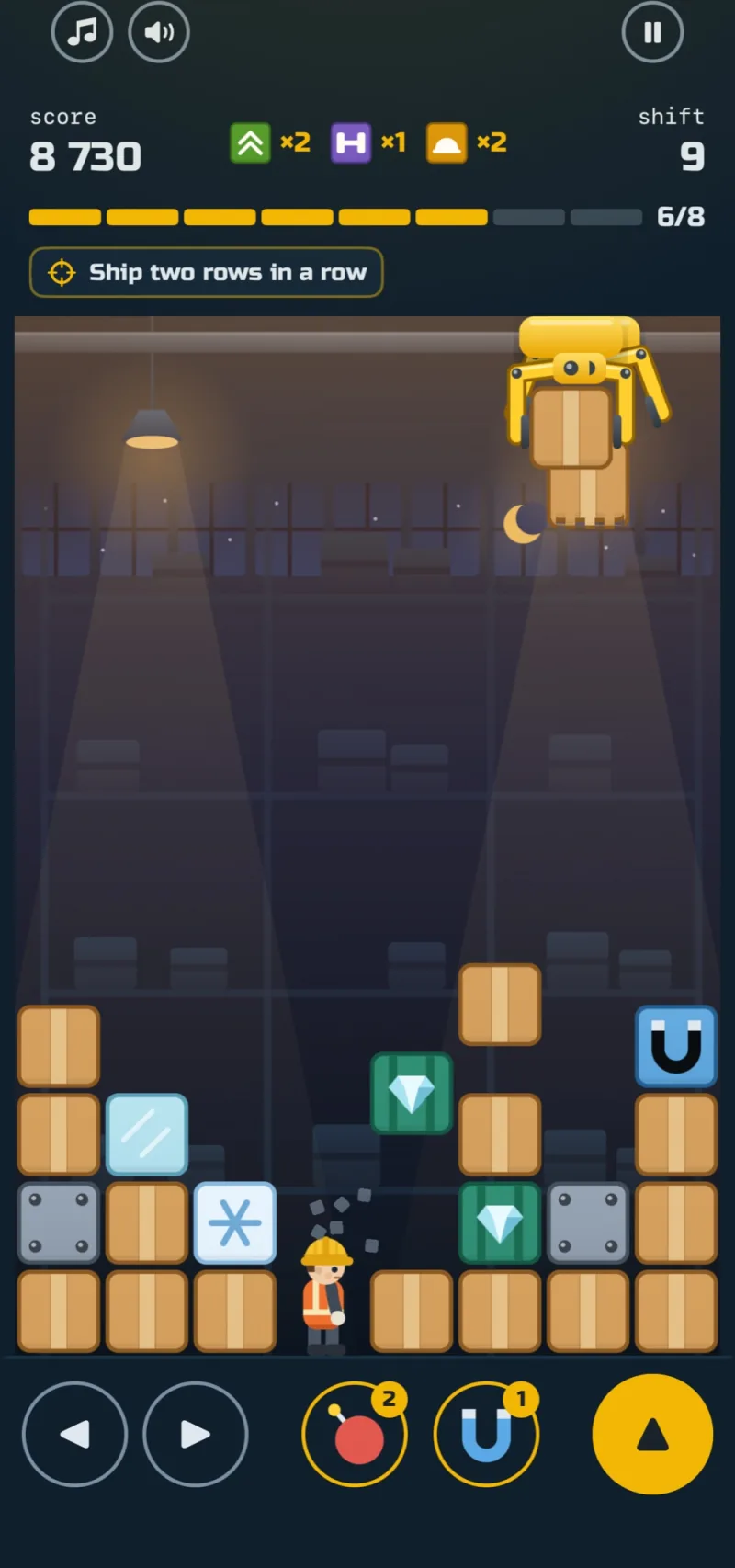
Speed enters in three ways. The crane and the music get faster with every shift. Some shifts change the rules, with extra steel, a rush, power cuts or extra dynamite. And the scoring rewards speed: ship a second row within 8 seconds of the first and the multiplier climbs, up to five times. The guide to scoring has the figures. There is no clock that ends your game; the pressure is the crane, not a countdown.
Here is the balance in practice. In the first shifts the pace is gentle, so use the time to build the second layer while waiting for the last gap in the first. When the second crane comes out, from shift 3, switch to simple moves: fill the lowest column, avoid standing under a drop, save the bomb for a column that is too tall. The tips page walks through these habits.
Choosing an action puzzle game
- Check how the speed rises. A gentle curve is learnable; a sudden spike is frustrating.
- See what a mistake costs. If you can retry quickly, you will learn faster.
- Look for a way to practise. Night Shift lets a new game start from shift 1 to 5 in the settings.
- Decide how much you want to think. Some action puzzles are mostly reflex with a puzzle coat; others are mostly planning with a tempo.
- Watch the extras. Optional ads that you choose to watch are acceptable to most players. Ads that interrupt you are not.
A final point on health claims: games like these are fun and absorbing, and some people find them a good mental warm-up. They are not a treatment, and nothing here says they make you smarter. They are a way to spend a pleasant ten minutes.
What is the difference between an action puzzle and a puzzle game?
A puzzle game waits for you to move. In an action puzzle the board keeps moving, so you plan and act in real time.
Is Tetris an action puzzle game?
It is often described that way, since pieces fall in real time while you decide where they go. The label is loose and no authority fixes it.
Is Night Shift an action puzzle game?
It fits the description: you plan where crates go while a crane keeps dropping them and a crate on your head ends the game.
If you enjoy this kind of game, how to play is a good next page.