Good Tetris strategy is mostly a handful of habits repeated until they are automatic: keep the stack flat, plan two moves ahead, leave an escape lane, and save your tools for real trouble. These seven habits work in any block or stacking puzzle, and each one comes with a small example, including how it applies in Night Shift.
1. Keep the surface flat
The first habit is to keep the surface flat. A flat surface accepts almost any new piece; a jagged one accepts only a few. When you have a choice between a placement that fits snugly but leaves a deep, narrow hole next to it and one that leaves a gentle slope, take the slope. Holes you cannot reach are what lose games.
In Night Shift the same idea sounds like “fill gaps, not height”. A row ships when every one of the eight columns has a crate on the floor, so a column that already has crates does not need more; the empty one does. Look for the lowest column first.
2. Stay low
The second habit is to stay low. Height is only useful as storage, and storage is a loan: it must be paid back with rows cleared. A pile that is only a few rows tall leaves time to think when something unexpected arrives. In Night Shift a column ten crates high ends the game, and long before that a tall column is a wall that splits the field.
3. Plan two moves ahead
The third habit is to plan two moves ahead. Before you place the piece in your hand, glance at the one coming next. If a preview exists, use it; if it does not, use the pattern of what has been falling. Example: if you hold a long flat piece and the next one is also flat, put the first one where it leaves room for the second instead of where it fits best on its own.
In Night Shift the crane is your preview. It carries a crate across the top before dropping it, so you see the column in time. Use those seconds to be at the right place, or to be well away from it.
4. Leave an escape lane
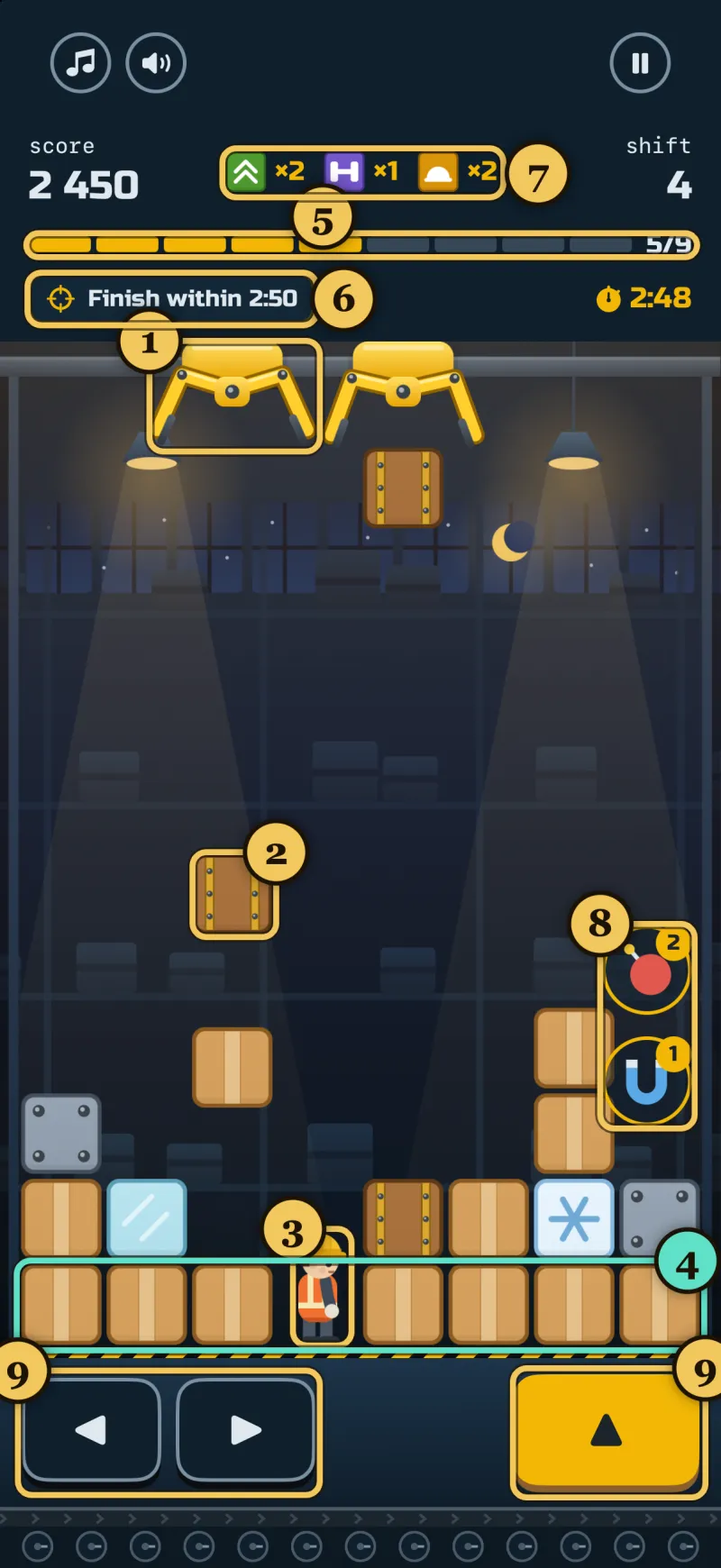
The fourth habit is to leave an escape lane. In falling-block games that is a column kept empty on purpose for a long piece, which many players call a well. In games where you move a character, it is a clear route to every part of the field. Night Shift is the second kind. A stack one crate high is a step you can climb; two high is a wall until you can jump, so a pair of tall columns can strand you away from the one gap you need.
5. Spend power-ups late
The fifth habit is to spend power-ups late. A tool used early solves a small problem and is gone when a big one arrives. Ask whether the trouble you face now could be fixed by ordinary play; if so, wait. Typical moments worth a tool are a column of eight or nine crates, a steel crate sitting where you need a gap, or a cluster of dynamite you want to chain from a distance.
The five upgrades of the game, helmet, jump, strength, bomb and magnet, are described in the upgrades guide. A hit also takes your jump and strength, so avoiding the hit is worth more than anything you can push.
6. Build two layers at once
The sixth habit is to build two layers at once. If the row above the bottom one is nearly complete while you wait for the last gap, both can clear one after another. In Night Shift that matters for the score: ship a second row within eight seconds of the first and the points go from 100 to 200, then 300, up to 500 for each row. The scoring guide has the full table.
| Row shipped within 8 seconds of the last | Points |
|---|---|
| First | 100 |
| Second | 200 |
| Third | 300 |
| Fourth | 400 |
| Fifth and later | 500 |
7. Distrust what looks finished
The seventh habit is to distrust what looks finished. A cell that seems filled may not be. In Night Shift a glass crate breaks when another crate lands on it, and a steel crate flattens cardboard as it lands, so a row that relies on a fragile crate is not safe until it ships. In a falling-block game the same warning applies to a row with a single unsupported block over a gap. If the thing you are counting on can vanish, count it as empty.
Learning the habits
Habits are learned one at a time. Pick one for a whole session, and ignore the rest. Here is an order that works for most people:
- Flatness. Notice every time you leave a hole, and ask why.
- Lowness. Check the height of your tallest column after each move.
- Looking ahead. Name the next piece before you place the current one.
- Lanes. Before building, check that you can still reach every part of the field.
- Tools. Write down, in your head, what would justify using one.
When something goes wrong, use the pause. Night Shift saves the game when you pause, so you can think about your next three moves and carry on from the same place.
Which habit matters most?
Keeping the surface flat. It prevents the most mistakes and makes every other habit easier.
Should I play fast or safe?
Safe first. Speed adds points, but only a game that survives can collect them. Add speed once flat play feels automatic.