A tower stacking game asks you to put things on top of each other and keep the pile standing, but the way it asks differs a lot. Some tower stacking games test your timing, some your sense of balance, some your planning, and a few turn the tower into the thing that is trying to beat you. Here is a plain map of the four kinds, what a tower that climbs toward a ceiling feels like, and habits that help in all of them.
Four kinds of tower stacker
Search for a stacking game and you get a pile of titles that look alike in thumbnails and play nothing alike. Sorting them by what they ask of your hands makes the choice much easier.
| Kind | What you do | What decides the result |
|---|---|---|
| Timing stackers | Tap to drop a moving block onto the tower | Your sense of rhythm and a steady eye |
| Balance stackers | Place pieces on a base that can tip or wobble | Where the weight sits and how gently you place it |
| Falling-block stackers | Steer pieces that fall by themselves so rows fill | Planning and speed under pressure |
| Builders | Raise a tower or city toward a target height | Choices and patience over many minutes |
Most games mix two of these. A timing stacker may add a balance twist; a falling-block game may ask you to think about height as well as rows. Still, one kind usually leads, and knowing which one tells you whether a game suits the minutes you have.
Timing stackers
In timing stackers a block slides back and forth above the tower. You tap, it drops, and whatever hangs over the edge is usually trimmed away, so the next block is narrower if you were careless. The skill is rhythm. Watch two or three passes before you tap, and tap on the beat rather than when you feel ready. If your last drop was ragged, slow your thinking down rather than speed up.
Balance stackers
Balance stackers use a physics simulation, so a pile that looks fine can lean and fall. The advice is the same as with real building blocks: put wide, flat pieces low, keep the heaviest piece near the middle, and place pieces gently instead of dropping them from a height. When the tower starts to sway, stop adding to the high side and fill the low one.
Falling-block stackers
Falling-block stackers are the family that includes the classic described in the story of Tetris. Here you do not choose when something arrives. You choose where it rests. Because mistakes stay on the board, the winning habit is to keep the surface flat and the pile low, which the page on block puzzle tips covers in detail.
Builders
Builders are slow on purpose. They hand you a growing tower and a set of choices about what goes where, and they reward planning more than reflex. They suit a long sofa session and rarely a bus ride.
When the tower climbs toward a ceiling
There is a specific feeling in games where the tower is not your goal but your danger. As the pile rises toward a ceiling, you get less room to move, fewer places to put things, and a calm start turns tense in a few seconds. Good games make that rise visible so you can act before it is too late.
Night Shift is built around that feeling. A crane at the top drops crates into eight columns, and a shift ends if a column grows ten crates high, or if a crate lands on the worker who has no helmet left. Your job is to keep every column low and to fill the lowest gap, because a row ships out when all eight columns hold a crate on the floor and the stacks above it sink one row. That makes the tower a thing you are always tearing down rather than building up.
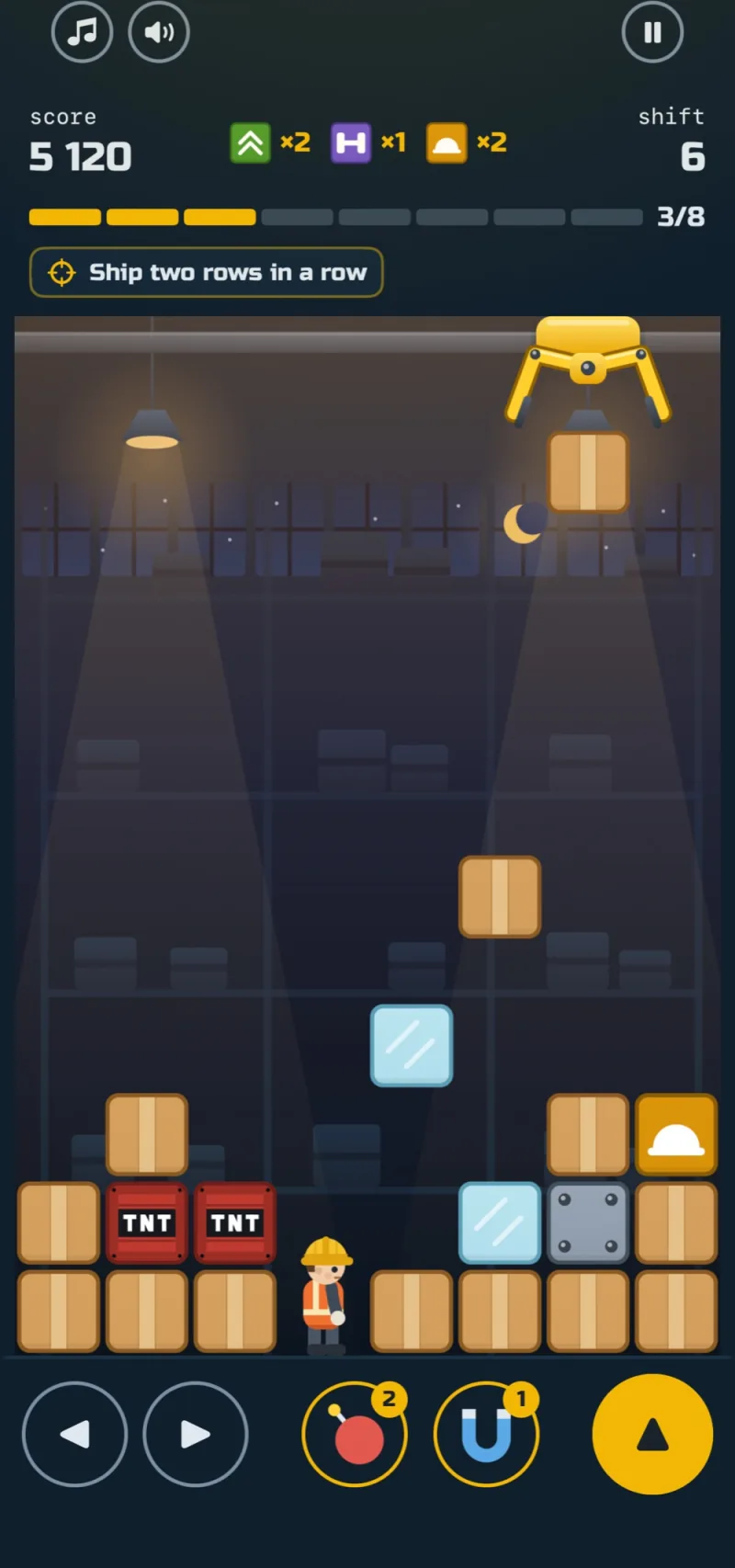
Unlike most stackers, you are inside the field. You can push a crate one column, climb a stack one crate high, and with the jump upgrade climb three. Two crates high is a wall until you can jump. That small detail changes the planning: a tall column in the middle splits the field and can cut you off from a gap on the other side. The crates guide shows how each kind of crate behaves when it lands.
Five tips that carry across
- Fill the lowest place first. A tower grows evenly when the lowest part gets the next piece.
- Keep a way across. In any game where you move or place things on both sides, a tall middle blocks you.
- Look before the drop. Cranes, sliders and previews all tell you what comes next a moment early; use that moment.
- Save the rescue tool for real trouble. In Night Shift that means the bomb, a one-off that clears the crates around you, rather than a way to tidy up.
- Slow down after a mistake. A second mistake almost always follows a rushed fix.
For this game in particular, the tips page goes through what to build and what to avoid.
Choosing one
If you have thirty seconds in a queue, take a timing stacker. If you want to sit down and think, take a builder. If you like a sprint that gets harder and ends in a clear loss you can learn from, choose a falling-block game, or one like Night Shift that adds a moving worker. Whichever you pick, check what needs a network: Night Shift plays offline, and only optional ads, purchases and leaderboards need a connection.
Which kind of tower stacker is easiest to start?
Timing stackers, because there is one action. Their difficulty comes from doing that one action well, again and again.
Is a taller tower always better?
Only in games where height is the goal. In games where the pile is the danger, a lower and flatter stack is safer and scores more.