Who invented Tetris? Alexey Pajitnov, a Soviet software engineer who wrote the first version in the mid-1980s, with 1984 given as the year the work began. The idea was tiny and sturdy: shapes fall, you fit them together, and full rows disappear. This page tells the origin story as it can be checked, and then follows the idea into the many games like Tetris that grew from it.
Who is credited
The person usually credited is Alexey Pajitnov. He worked at the Dorodnitsyn Computing Centre of the Soviet Academy of Sciences in Moscow, where he wrote programs and tried out ideas for fun. Public sources agree on that much, though they differ on exact dates: work is usually described as starting in 1984, and some accounts date a finished first version and the Soviet release to 1985. If you see two years quoted, that is the reason, not a mistake by one of the writers.
He did not work alone for long. His colleagues Dmitry Pavlovsky and Vadim Gerasimov helped bring the game to the IBM PC, which let it spread far beyond the machine it was born on. That early help is why the story is sometimes told with more than one name.
How it began
Pajitnov liked physical puzzles, and one he played with was a set of pentominoes: twelve flat shapes, each made of five squares joined edge to edge. He wanted a version a computer could run. Pentominoes turned out to be too many and too awkward to handle in a quick game, so he scaled the idea down to tetrominoes, the seven shapes you can make from four squares. The name joins the Greek word for four, “tetra”, with tennis, his favourite sport.
The first version ran on an Elektronika 60, a Soviet computer modelled on the PDP-11, and it took only a few weeks to program. It drew shapes from characters on a text screen. There was no colour and nothing fancy. What mattered was the loop, and it was already complete.
The idea in two sentences
Strip away the art and the rules fit in two sentences. A piece falls from the top. You steer and turn it so that it lands without gaps, and any row that is completely filled vanishes, giving you room to continue. Everything else, the speed, the score, the preview of the next piece, was added around that centre.
- Pieces fall on their own, so time is always pressing on you.
- You decide only where a piece rests, which makes every choice small and easy to understand.
- Clearing a row gives back space, so good play is rewarded with more time to play.
- Mistakes stay on the board, so a bad choice is still there ten moves later.
That last point is what makes the game feel fair. Nothing random hits you without a reason; your own earlier choices pile up. It is also why a short game can still feel like a story with a beginning, a tense middle and a finish.
How it spread
The game travelled from person to person on disks before it travelled through contracts. Rights were then handled by the Soviet state organisation Elorg, and different companies released versions in the late 1980s: a British publisher and an American one in 1988, a Japanese company with computer and Famicom versions in 1988, and in 1989 Nintendo obtained the handheld and console rights. The Game Boy version of 1989, packed in with the handheld in the United States, is the one many people remember as their first Tetris.
| Year | What happened |
|---|---|
| 1984 | Work begins in Moscow, according to the usual account |
| 1985 | A first complete version is dated here by several sources |
| 1988 | Versions released in the United Kingdom, the United States and Japan |
| 1989 | Game Boy and NES versions arrive |
| 1996 | Pajitnov and Henk Rogers found The Tetris Company |
How the idea branched
Once an idea this clear exists, others borrow its parts. Some games kept falling pieces and changed the shapes. Some kept the rows and swapped the shapes for jewels, bubbles or numbers. Some kept the feeling of order slowly beating chaos, and turned the player into a character inside the field.
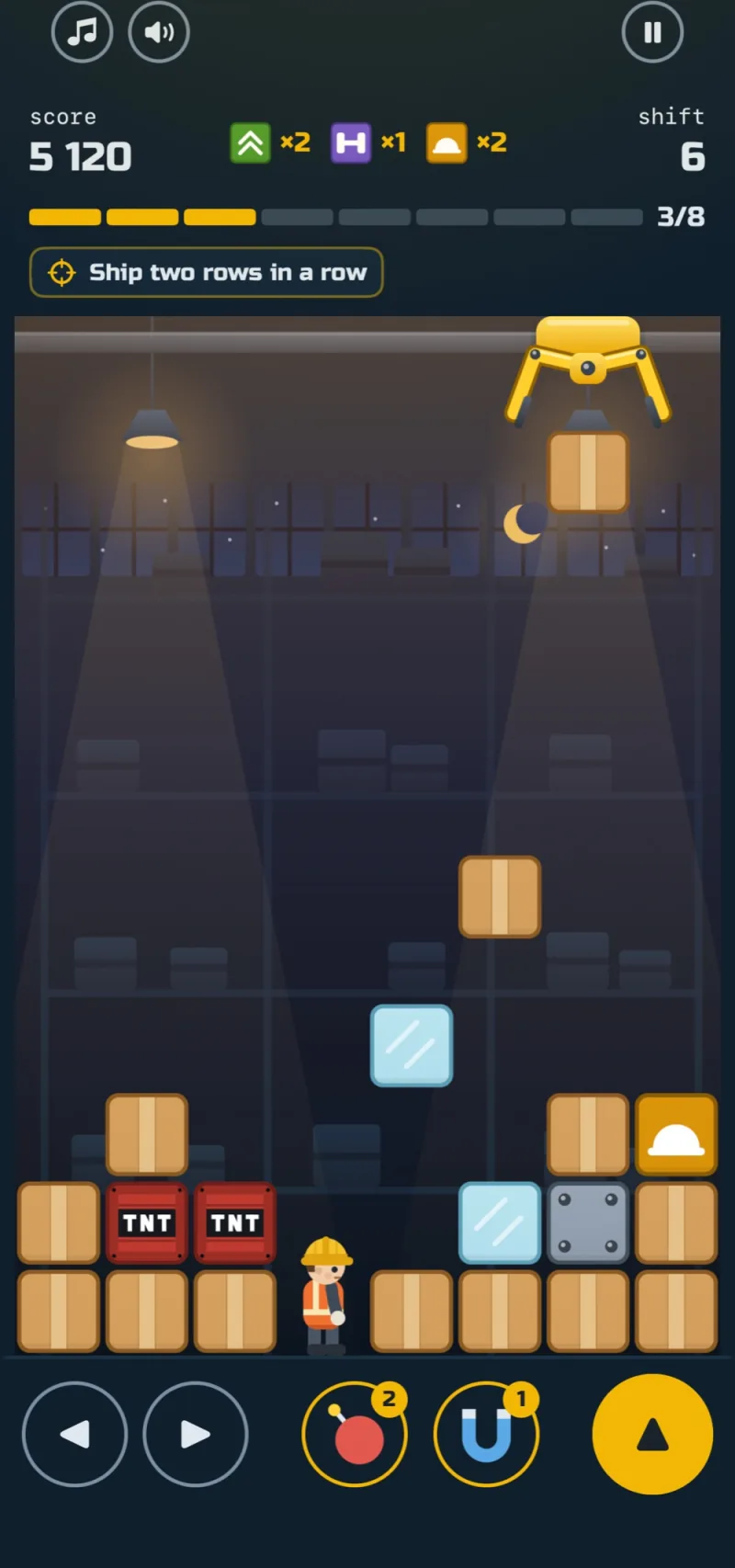
Night Shift sits in that last group. A crane drops crates into eight columns, and you walk, jump and push them where they should go. A row ships out when every column has a crate on the floor, whatever the crates are made of, so you fill gaps rather than turn shapes. Every shift is a little faster than the last, and the shift is signed off after eight rows or more. The ancestry shows, but the verbs are different: you move, not the piece. The rules page shows each part on a real screen.
Why it lasted
Games age badly when they depend on a gimmick. This one depends on a rule people already understand: fill the space. That is why it moved to every new machine, from desk computers to handhelds to phones, with almost no explaining. It is also why newcomers keep finding it, and why “who invented Tetris” is still a question that gets typed into a search box today.
If the history made you want to play with the idea rather than read about it, the practical side is in seven habits for a low stack, which applies to any block game.
Did one person invent Tetris?
Alexey Pajitnov is credited as its creator and wrote the first version. Colleagues, notably Dmitry Pavlovsky and Vadim Gerasimov, helped bring it to other computers.
Was Tetris made in 1984 or 1985?
Both years appear in public sources. Work is usually said to have started in 1984, and a finished first version and release are often dated to 1985.
Where does the name come from?
It joins “tetra”, Greek for four, since every piece is made of four squares, with tennis, the creator’s favourite sport.
Keep reading: games like Tetris; tips for Night Shift.