The Tetris effect is the name people give to seeing falling shapes, in your head or behind closed eyelids, after hours of playing a block game. This page explains what the term means, where it comes from, what is known and not known about it, and why long, repetitive, spatial games leave traces in what you see. It is careful and non-medical.
What the Tetris effect is
Play a falling-block game for long enough and you may find the game follows you. You close your eyes at night and see blocks dropping. You walk past a shelf and your mind tries to fit the objects together. You look at a building and notice where a piece would slot into a gap. That experience is the Tetris effect.
It is common, usually brief and not a sign that anything is wrong. It is also not limited to one game: people report it after jigsaws and after other games with strong visual patterns.
Where the name comes from
The earliest known use of the term in print is a May 1994 article by Jeffrey Goldsmith in Wired called "This is Your Brain on Tetris". Later writers took the name up; it is not credited to one person, and various gamers were using it in the mid-1990s. The block game it refers to was created by Alexey Pajitnov in 1984.
A well-known scientific paper followed in 2000: Robert Stickgold and colleagues published "Replaying the Game: Hypnagogic Images in Normals and Amnesics" in the journal Science. Hypnagogic images are the pictures and scenes that appear as you fall asleep.
What the research reported
In that paper, people who played the game for an extended time reported vivid images of falling blocks as they dozed off. The surprising part was a group of amnesic patients, who could not form new memories of events. They had no memory of having played, yet some of them also reported seeing falling shapes as they went to sleep.
The authors suggested that this imagery reflects a form of memory separate from the memory of events, one related to how we learn skills. That is a proposal, not a settled conclusion. Later writers have also used the umbrella term "game transfer phenomena" for the broader group of effects in which gaming experiences carry into everyday life, such as hearing game sounds in ordinary noises or reaching for a button that is not there.
What is not known
- No one has shown why some players get the effect strongly and others hardly notice it.
- The explanation involving skill memory is a hypothesis. It has not been proven.
- Claims that it makes you smarter, protects the brain or treats a condition go beyond what is established. Treat them with care.
- The effect has not been clearly measured as a medical risk. Heavy, long play can still tire the eyes and hands, as anything repetitive can.
Beyond what I could check, I leave the figures out. Several studies on gaming effects are small, and their results should not be quoted as facts without their context.
Why repetitive spatial games leave traces
There is no single agreed answer, but the pattern is easy to describe. Games like these have a few features that make them stick.
- Repetition. The same action, thousands of times, trains the visual system to expect it.
- Spatial focus. Your attention is locked on shapes, gaps and fit, so the habit transfers to any scene with shapes.
- Unfinished business. Your mind likes to complete a pattern, so it keeps trying to place the pieces.
- Fatigue and the edge of sleep. Tired minds replay recent experience as they drift off.
- Rewards on a beat. A satisfying clear every few seconds makes the pattern memorable.
| What people report | Where it appears |
|---|---|
| Seeing blocks falling when eyes are closed | As you fall asleep or at rest |
| Mentally fitting objects into gaps | When looking at shelves, cars, buildings |
| Thinking in the game's moves | Between sessions or at work |
| Hearing the game's tune | After long music-heavy sessions |
Does Night Shift cause it?
Night Shift is a stacking game and shares the ingredients. A crane drops crates into eight columns, you push them into place, and every full bottom row ships out for points. It is repetitive, spatial and fast, so after a long session a player might well see crates and gaps afterwards. I have no data to say how often, and the game does not claim anything about it.
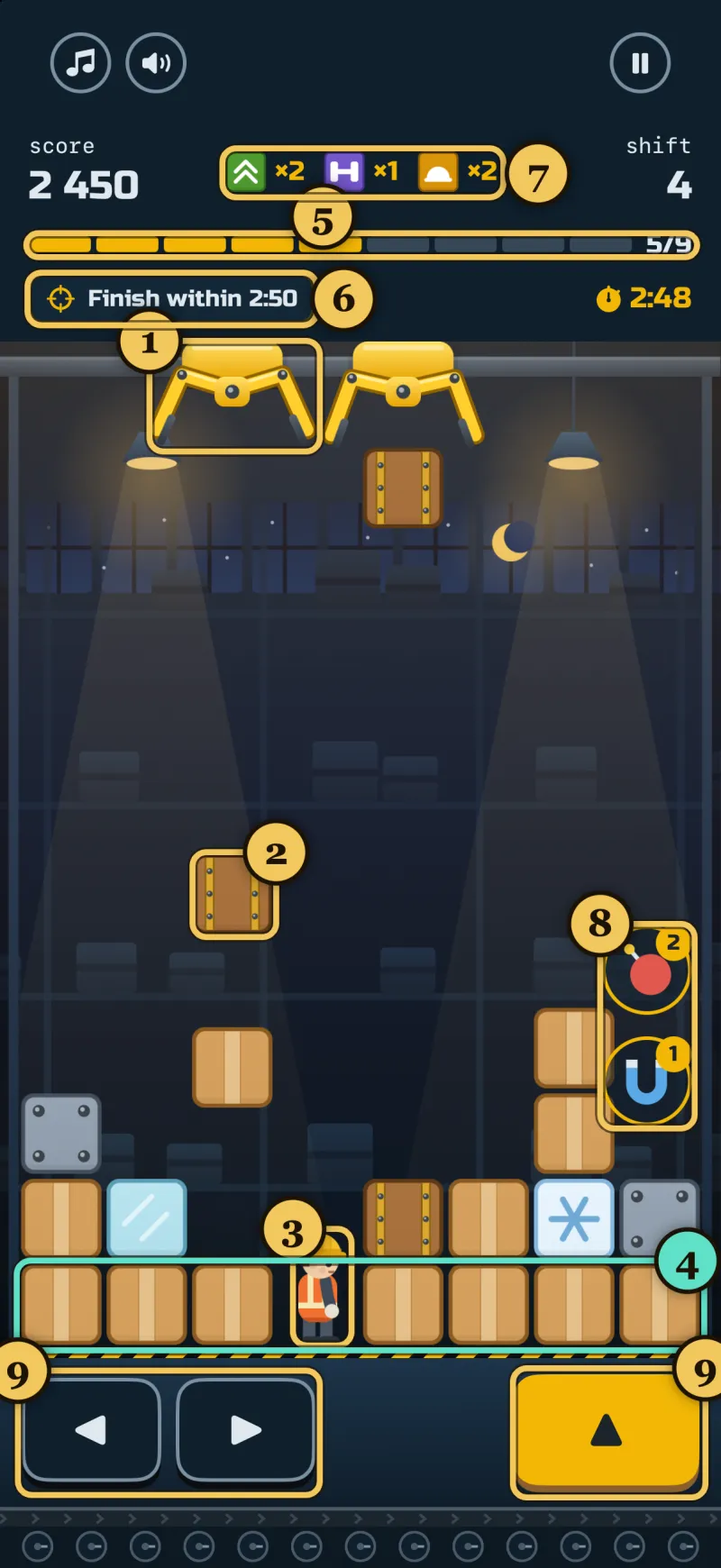
What I can say is how to enjoy it with common sense. The game saves whenever you pause or leave, so you can stop at any time, and the rules are small enough to learn quickly. If you want to keep the effect mild, take regular breaks, stop before you are tired and avoid playing as the last thing before sleep. The tips page is about play, not about your head.
Practical advice if you notice it
- Take it as a sign of absorption. It means you were focused, not that something is wrong.
- Rest your eyes. Look into the distance every twenty minutes or so.
- Change activity. A walk or a different task usually clears it.
- Leave the game before bed. If images keep you awake, play earlier in the day.
- Ask for advice if it troubles you. If images are distressing, constant or come with other symptoms, speak to a doctor.
Is the Tetris effect normal?
It is commonly reported, usually brief, and generally not considered a problem. If it distresses you, talk to a professional.
Does it prove that block games change the brain?
No. The research reported a kind of imagery and proposed an explanation. It does not show lasting benefit or harm.
Can other games cause it?
Yes. People report similar effects after other games and repetitive visual activities.
For another view of the same topic, read the FAQ.