Games with bombs use explosions as a way to think, not just a way to destroy. A good bomb is a decision: it clears a space, but it costs you something and sometimes sets off a chain you did not plan. This page looks at how bombs and dynamite work as puzzle mechanics, the main designs you will meet, and how Night Shift handles them.
Why bombs make good puzzle pieces
A bomb changes the board in one move. That makes it powerful, and power in a puzzle needs a price, or the game becomes trivial. The interesting designs make you ask three questions every time: where, when and what else will go?
- Where. Most blasts have a fixed shape, so placing one is a spatial puzzle in itself.
- When. A fuse or delay lets you move away, or lets others walk into it. Timing becomes part of the plan.
- What else. Blasts that set off other explosives create chain reactions, which is where the fun and the danger live.
Four common designs
| Design | How it works | What you decide |
|---|---|---|
| Timed bomb | You place it and it goes off after a delay | Where to place it and where to be when it blows |
| Area clear | A one-use item removes everything in a zone | When the board is bad enough to spend it |
| Chain reaction | One explosion sets off neighbouring explosives | The order and spacing of explosives |
| Hazard crate | Explosive objects on the board that you must handle | Whether to avoid, defuse or detonate on purpose |
Bomberman is the classic example of the first design. According to its public history, the first game appeared in Japan in July 1983, made at Hudson Soft, and the series has you place bombs that go off after a short time, in several directions, so you must run clear of your own blast. Power-ups can enlarge the explosion or let you place more bombs. It is an arcade maze, but it shows how a delay turns a weapon into a puzzle.
Why a bomb should be a decision
A bomb that you can spam every second is not a decision. It is a button. Designers make it a decision in a few ways, and you can use the same questions to judge any game.
- It is scarce. If you have two, you think about which problem deserves one.
- It is risky. If your own blast can hurt you or clear something you wanted, you must plan.
- It has a side effect. Clearing a crate may also drop the stack above it into the hole, which can help or ruin your row.
- It is the answer to one specific problem. A tall column, a locked gap, a cluster of explosives you want to chain.
How Night Shift uses bombs and dynamite
Night Shift has two explosive things, and they behave differently on purpose. In this stacking game a crane drops crates into eight columns, you push them into place, and a full bottom row ships out for points.
The bomb upgrade
The bomb is a pickup that falls from the crane, and you can also bring spares from the shop. Tap the bomb key and a bomb goes down in your own cell. About a second later it destroys every crate in the cells one step around it, steel and valuable cargo included. Crates standing higher in those columns drop into the hole. Your own bomb does not hurt you, and each crate it destroys scores 5 points.
That is a decision. A bomb is best saved for a column that has grown dangerously tall, for steel blocking a gap you cannot push through, or for setting off dynamite from a distance. Waste it on an easy gap and you will miss it later. The upgrades guide shows all of this with pictures.
Dynamite crates
Dynamite is a normal-looking crate until something sets it off: a steel crate landing on it, a bomb, or another dynamite going off next to it. Then it destroys every crate in the 3×3 cells around it, and a second dynamite caught in the blast goes off a moment later, and so on. That is the chain reaction.
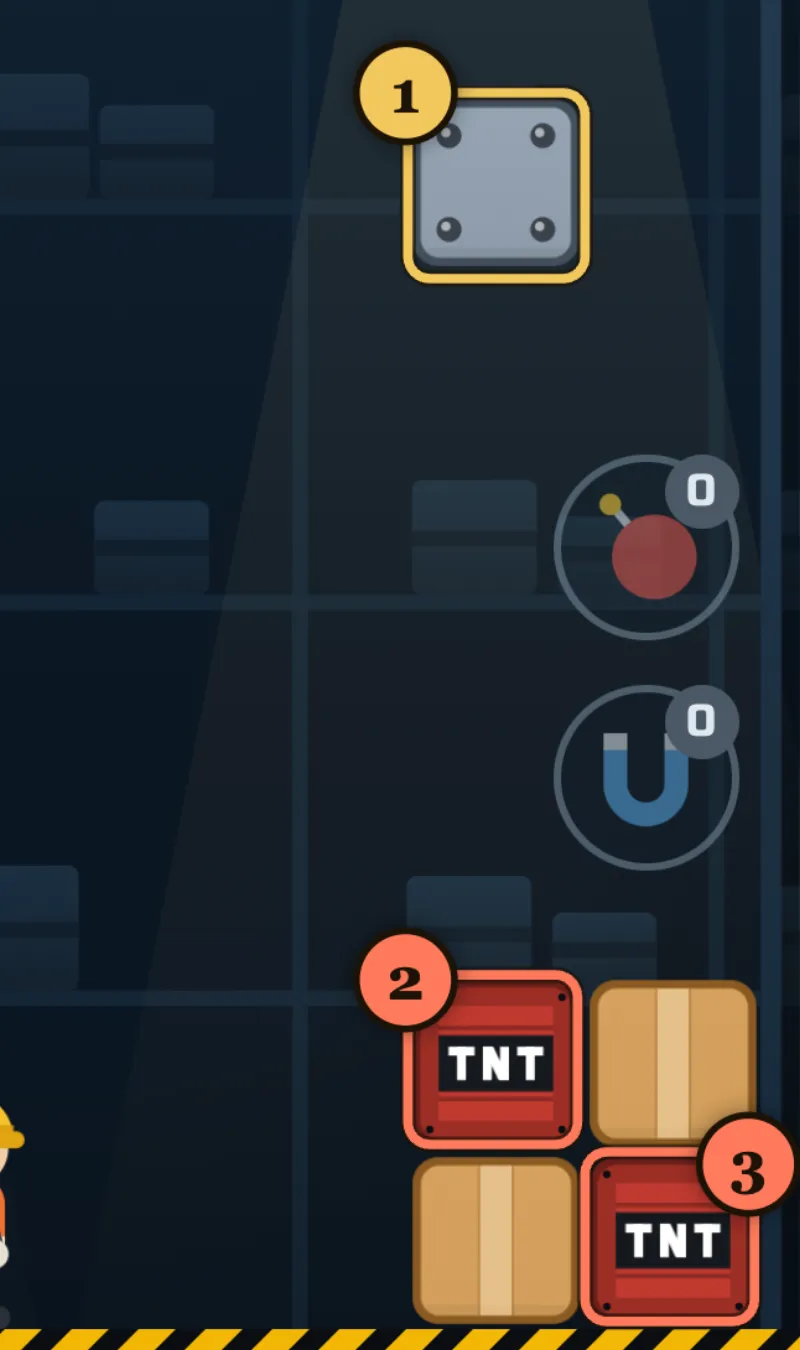
Here the explosion is also a hazard. Dynamite's blast hurts you: stand within its cells and you lose a helmet, and with none left the game is over. The bomb never hurts you, but dynamite always does. So the rule of thumb is to detonate dynamite from afar with a bomb, or stay out of the blast zone, which turns a bomb and a stack of dynamite into a small puzzle: set it off while you are somewhere else, and clear what you need.
Dynamite first falls in shift 2, and an Explosive shift brings far more of it, about one crate in eleven. The crates guide lists every kind, and shifts and tasks explains the Explosive shift.
A worked example
Say you have a gap in the bottom row, but a steel crate sits on top of it and you have no strength to push it. You also have a dynamite crate two columns away that you do not want to touch.
- Stand clear of the dynamite, at least outside its 3×3 blast cells.
- Move to the steel crate and place a bomb in your own cell. You are safe from it.
- Step away during the second before it goes off. The bomb clears the cells around it, including the steel.
- If the blast reaches the dynamite, it chains. Check where you are standing before you decide.
- Crates above the hole drop in. Check the bottom row: if every column now has a crate, it ships.
The point is not the exact steps, since boards differ, but the questions: where am I, what is near, what falls afterwards.
What to look for in other games
- Is the explosion shape clear and consistent? If you cannot predict it, it is luck.
- Can you hurt yourself? Some games forgive it, others make it the whole challenge.
- Do chains reward planning? The best chain reactions are ones you can set up.
- Is the bomb limited? Unlimited bombs rarely make a puzzle.
- Is it fun to fail? A good explosion game makes a mistake funny rather than cruel.
Does my own bomb hurt me in Night Shift?
No. Your own bomb never hurts you. Dynamite always does, if you stand in its blast cells.
How do I get bombs?
They fall from the crane as rare red pickups. Spares can also come from supply crates in the shop, which are optional in-app purchases.
Can I use bought bombs in the daily challenge?
No. Bought supplies are not used in the daily challenge, though bombs that fall from the crane work as usual.
For the strategy, see the tips.